Introduction
Every academic year brings important decisions for students and parents. A student in secondary school may struggle with mathematics concepts. A senior secondary student may need focused practice for entrance tests. A high school graduate must pick a suitable college and degree program.
Too often, families make these choices based only on word-of-mouth advice or unverified promotional claims. Making the wrong choice can lead to lost time, unnecessary financial expense, and academic stress.
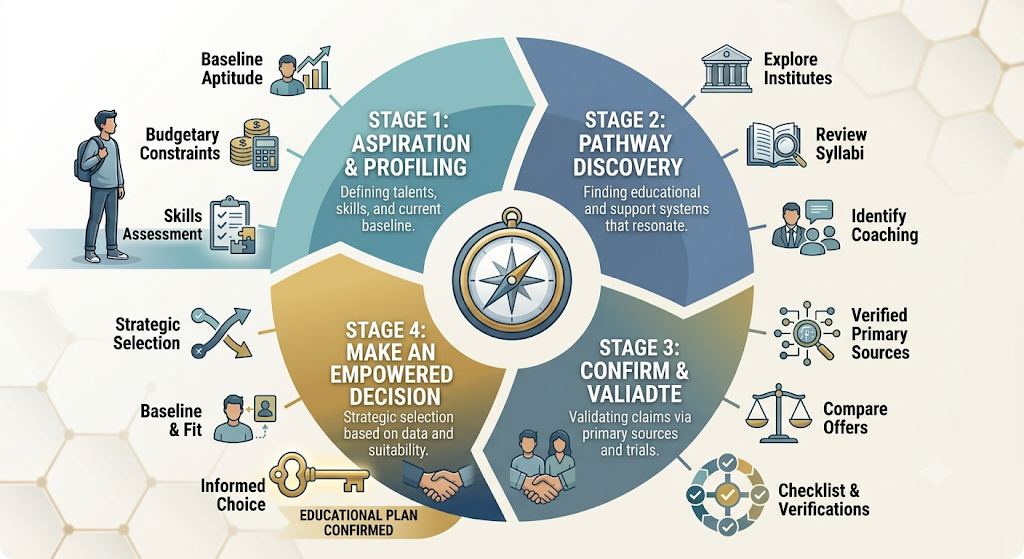
A structured approach to education discovery helps you evaluate options clearly. By understanding your specific learning needs, comparing learning formats, and reviewing verified facts, you can make confident educational choices at every stage.
Finding the Right Academic Support: Online vs. Local Tutors
When a student struggles with a subject, individual attention often makes a significant difference. Classroom teachers must attend to dozens of students at once. A dedicated tutor can slow down, spot learning gaps, and explain difficult concepts at the student’s pace.
Today, learners have two main avenues: private home tutors or remote instruction.
Deciding Between Online and Local Tutors
To choose the right format, evaluate how the student learns best and consider practical home routines.
- Local Tutors (In-Person): Face-to-face instruction works well for younger learners or students who lose focus during screen-based classes. Working with a tutor nearby allows hands-on supervision for homework and structured problem-solving. When you look to find tutors near me, travel time and neighborhood accessibility matter.
- Online Tutors: Learning online removes geographic limits. A student living in a smaller town can learn from an experienced subject mentor in another city. Parents can easily find tutors online who specialize in niche subjects, international boards, or advanced entrance exam syllabi. Sessions can also fit around tight school schedules.
| Factor | Local Tutors (Near Me) | Online Tutors (India-Wide) |
| Best For | Hands-on guidance, focus support, younger students | Niche subjects, flexible timings, broad selection |
| Geographic Reach | Limited to local area | Anywhere with reliable internet connection |
| Schedule | Fixed around travel and home availability | Greater flexibility for early morning or evenings |
| Interaction | Direct physical presence and paper-based correction | Digital whiteboard, shared screen, recorded lessons |
Essential Factors to Check Before Hiring a Tutor
Never select a teacher based only on an advertisement. Use these objective checkpoints during your initial discussions:
- Subject Expertise and Academic Background: Does the tutor have relevant academic training in the subject? A tutor teaching high school physics must understand board expectations and underlying mathematical concepts.
- Teaching Experience: Ask how many years the tutor has taught students at your child’s grade level. Teaching a Class 6 student requires different methods than guiding a Class 12 candidate.
- Clear Learning Goals: Discuss what you hope to achieve. Are you looking for regular homework support, basic concept clearing, or advanced exam problem practice?
- Trial Class and Communication Style: Arrange an initial demo session. Observe whether the tutor listens patiently and encourages questions, or simply lectures without checking for comprehension.
- Fee and Schedule Clarity: Understand the fee structure upfront. Confirm whether billing is monthly or hourly, and clarify rules for rescheduling missed classes.
Choosing Coaching Institutes for Academic and Competitive Prep
Coaching centers remain a major part of education in India. Many students join these centers for board exam preparation or competitive entrance exams. However, marketing campaigns often make every center look identical.
To find the right institution, move past promotional banners and focus on teaching systems.
What Makes a Coaching Institute Effective?
Many families search online for the best coaching institutes in India. The word “best,” however, is subjective. A center that works well for a self-motivated top ranker might overwhelm a student who needs steady foundation building.
When shortlisting coaching institutes near me, evaluate these core factors:
- Permanent Faculty vs. Visiting Teachers: Inquire who actually teaches the core subjects. Institutes with stable, full-time faculty offer consistent teaching. Centers that rely heavily on temporary guest teachers often suffer from abrupt syllabus disruptions.
- Batch Size and Personal Attention: Classes with 150 or more students limit direct interaction. If your student hesitates to ask questions in large crowds, look for centers with smaller batches or dedicated doubt-clearing sessions.
- Study Materials and Practice Testing: Quality institutes supply well-organized, updated study material aligned with the latest exam patterns. They also hold regular tests that simulate real exam conditions and provide detailed answer analysis.
- Proximity and Travel Time: Daily travel causes physical fatigue. If an institute is two hours away, the daily commute drains energy needed for self-study. A reliable local center often yields better overall results than a distant center that exhausts the learner.
- Transparent Refund and Fee Policies: Review fee structures, instalment plans, and cancellation policies in writing before making large upfront payments.
Planning for Competitive Exams in India
Navigating entrance tests requires early planning and a clear view of official syllabi. Millions of students sit for national and state-level exams each year, making competition rigorous.
Common Competitive Exams After 12th
Students completing senior secondary school can choose among several established entrance pathways:
- Engineering: The Joint Entrance Examination (JEE Main) serves as the screening gateway for NITs, IIITs, and Centrally Funded Technical Institutes, as well as the eligibility test for JEE Advanced (for the IITs). Many states also conduct their own engineering entrance tests.
- Medical and Allied Sciences: The National Eligibility cum Entrance Test (NEET-UG) is the single national entrance test for admission to undergraduate medical (MBBS), dental (BDS), and AYUSH courses across India.
- Central Universities and Liberal Arts: The Common University Entrance Test (CUET-UG) allows students to apply to central, state, and participating private universities for bachelor’s degrees across sciences, commerce, and humanities.
- Law: The Common Law Admission Test (CLAT) and the All India Law Entrance Test (AILET) are primary entrance exams for national law universities.
- Design and Architecture: National Institute of Fashion Technology (NIFT), National Institute of Design (NID) DAT, and NATA (for architecture) test spatial ability, drawing, and design aptitude.
| Stream | Primary Entrance Exam | Conducting Body / Key Focus |
| Engineering | JEE Main / Advanced | NTA / Selected IITs (Physics, Math, Chemistry) |
| Medical | NEET-UG | NTA (Physics, Chemistry, Biology) |
| Multi-Domain | CUET-UG | NTA (Domain Subjects, Language, General Test) |
| Law | CLAT / AILET | Consortium of NLUs / NLU Delhi (Reasoning, Legal, English, GK) |
| Design | NID DAT / UCEED | Respective Institutes (Aptitude, Visual Perception, Design) |
Steps for Realistic Competitive Exam Preparation
Success in competitive exams in India requires steady discipline rather than last-minute cramming. Consider these baseline preparation practices:
- Understand the Prescribed Syllabus First: Download the official syllabus directly from the exam conducting body’s website. Do not rely solely on summarized notes from secondary sources.
- Master Core Textbooks: For science and mathematics examinations, NCERT textbooks remain essential for establishing conceptual fundamentals before moving to advanced problem books.
- Establish a Sustainable Daily Routine: Set realistic daily study goals of four to six focused hours outside of school, rather than unsustainable fourteen-hour schedules that cause burnout.
- Analyze Previous Years’ Question Papers: Solve past papers under timed conditions. This reveals recurring concept areas, question framing styles, and personal timing bottlenecks.
- Review Mistakes Methodically: Keep an error log. Record whether errors stemmed from conceptual confusion, calculation mistakes, or misreading the question. Revisit these weak spots weekly.
Higher Education Pathways: College and Course Discovery
Selecting where to complete your undergraduate or postgraduate degree shapes your early career network and professional skills. However, commercial advertisements and marketing materials can make objective evaluation challenging.
Conducting a thorough college search in India requires systematic research across public portals and institutional disclosures.
How to Compare Colleges and Courses
When you compare colleges and courses, look past marketing claims and examine verifiable metrics:
- Affiliation and Regulatory Approvals: Verify that the college holds valid recognition from relevant statutory authorities. Check approvals from the University Grants Commission (UGC), All India Council for Technical Education (AICTE), Bar Council of India (BCI), or National Medical Commission (NMC).
- Curriculum Structure: Review the actual semester syllabus. Does the course include current industry topics, laboratory electives, or research projects? A degree with an outdated curriculum leaves students playing catch-up on practical skills after graduation.
- Faculty Composition: Check the department directory on the college website. Are key subjects handled by experienced faculty with doctoral degrees, or is the department run primarily by short-term lecturers?
- Campus Infrastructure and Labs: Practical learning requires functional laboratories, computing facilities, and accessible libraries. When possible, visit the campus or speak directly with current students to verify that equipment and libraries are actively maintained.
- Verifiable Career Support: Look closely at placement reports. Distinguish between average packages and median packages; a few unusually high salaries can skew the reported average. Note whether companies recruit for core engineering and technical roles or general sales positions.
How Education Discovery Platforms Simplify the Search
Students and parents often spend weeks gathering details across disconnected websites, social groups, and local bulletin boards. This fragmented search leads to decision fatigue.
An education discovery platform organizes this data into a single, searchable environment.
The Role of GurukulGalaxy
Platforms like GurukulGalaxy help families explore education options systematically. Rather than acting as a traditional coaching center or college, the platform serves as an informative discovery directory.
Through GurukulGalaxy, education seekers can:
- Search for individual teachers and online tutors in India based on subject requirements and class levels.
- Discover local learning options, including verified home tutors and nearby training institutes.
- Review structured details about schools, colleges, and training academies.
- Access foundational guidance regarding competitive exam structures, eligibility rules, and academic pathways.
Using an organized directory helps students and parents compare options side-by-side. This ensures educational decisions are grounded in transparent facts, verifiable profiles, and direct inquiries.
Practical Checklist for Students and Parents
Before paying admission deposits or signing up for coaching programs, complete this practical review:
- [ ] Define the primary need: Is the student struggling with basics, or do they need advanced exam strategy?
- [ ] Verify official credentials: Are college affiliations, institutional accreditations, or teacher qualifications confirmed?
- [ ] Calculate the total investment: Have you accounted for application fees, course books, transport, and examination costs alongside tuition?
- [ ] Test the commute or setup: For offline centers, can the student travel there without exhaustion? For online classes, is home internet access stable?
- [ ] Insist on an initial interaction: Has the student spoken with the tutor or attended an orientation before finalizing enrollment?
FAQ Section
How do I choose between an online tutor and an offline tutor?
Base your choice on the student’s age, self-discipline, and location. In-person tutors offer physical supervision and help younger students stay focused. Online tutors provide access to subject specialists nationwide, flexible hours, and eliminated commute times.
What should I check before joining a coaching institute?
Evaluate the stability of the permanent teaching faculty, average batch sizes, and the quality of practice tests. Ask whether dedicated doubt-clearing sessions are provided, and review fee refund policies in writing.
Which competitive exams can students take after 12th?
Key options include JEE Main for engineering, NEET-UG for medical courses, CUET-UG for central and state university degree programs, CLAT for law, and NID DAT or NATA for design and architecture.
How can I verify if a college is officially recognized?
Check official regulatory directories online. Confirm approval from statutory bodies such as the University Grants Commission (UGC), AICTE for technical courses, or the Bar Council of India (BCI) for legal education.
What is the difference between average salary and median salary in college placement reports?
The average salary combines all offers and divides by the number of students, which can be distorted by a few very high salaries. The median salary represents the midpoint value where half the class earned more and half earned less, giving a more realistic picture of typical student outcomes.
How early should a student begin competitive exam preparation?
Most students begin dedicated preparation in Class 11 for major national exams like JEE or NEET. Starting with fundamental concepts in secondary school builds a steady base, but extreme test cramming in early childhood can lead to unnecessary burnout.
Can an education discovery platform guarantee college admission or exam ranks?
No reliable discovery platform can guarantee admission, job placements, or exam ranks. Platforms provide structured directories, institutional data, and tutor profiles to help families research and compare options independently.
How do I verify a private tutor’s credentials?
Ask about their formal educational background, degrees, and prior teaching experience at your student’s grade level. Request a trial session to observe their communication style and evaluate how well they explain challenging concepts.
Conclusion
Finding the right educational pathway is rarely about choosing the most advertised name; it is about finding the environment that aligns with a student’s personal goals and pace of learning. Rushing into decisions based on unverified claims or neighborly advice often creates unnecessary stress and financial strain.
By taking a structured approach—clarifying academic needs, examining faculty continuity, checking official accreditations, and using transparent discovery platforms—parents and students can replace guesswork with informed confidence. Thoughtful planning at each milestone builds a sustainable foundation for lasting academic growth and career success.