Introduction
Online health research has become the primary starting point for individuals exploring reproductive health, yet sorting through digital medical information can quickly feel overwhelming. When evaluating family-building pathways, prospective patients encounter an extensive mix of clinical terminology, complex procedural breakdowns, promotional clinic announcements, varying price summaries, outcome statistics, and international programs.
Because commercial marketing often blends with clinical education online, finding transparent, objective guidance requires careful navigation. Commercial advertisements, patient forums, and headline pricing can present conflicting views of what care entails. Establishing a structured, systematic approach to digital research helps individuals filter promotional claims, comprehend core terminology, and prepare constructive, informed conversations with qualified medical specialists.
Navigating Modern Reproductive Care Pathways
Every reproductive journey begins with unique clinical, genetic, and personal factors. Medical history, underlying reproductive diagnoses such as polycystic ovary syndrome (PCOS) or endometriosis, diagnostic test results, and age all shape clinical discussions. Because no two medical profiles are identical, individuals benefit from exploring the full spectrum of fertility treatment options before assuming a specific clinical path is required.
Initial care pathways often range from basic lifestyle modifications, ovulation induction, and timed intercourse to intrauterine insemination (IUI). Advanced interventions involve laboratory-assisted procedures or third-party reproduction. Educational materials online can clarify what each pathway involves mechanically and biologically. However, digital health information should never serve as a self-diagnosis engine or a substitute for diagnostic evaluations performed by licensed reproductive endocrinologists.
Comparing Laboratory Approaches to Fertilization
Among advanced assisted reproductive technologies, laboratory procedures differ primarily in how fertilization is facilitated. In conventional in vitro fertilization, retrieved eggs and prepared sperm are placed together in a specialized laboratory dish, allowing fertilization to occur spontaneously.
By contrast, intracytoplasmic sperm injection is a targeted micro-manipulation technique where a single, selected sperm cell is injected directly into the cytoplasm of a mature egg. When reading literature comparing ICSI vs IVF, patients often learn that the targeted injection technique was historically developed to address severe male-factor indications, such as low sperm count, poor motility, or previous unexpected fertilization failure. Recognizing these functional distinctions helps individuals interpret clinical articles accurately and avoid assuming that advanced laboratory interventions are universally necessary for every patient.
Evaluating Prospective Reproductive Facilities
Choosing a clinical care team requires looking beyond public ratings, facility photos, or marketing slogans. Prospective patients need to evaluate whether a facility has the specialized expertise and laboratory capabilities suited to their medical needs. When individuals begin to compare IVF clinics, assessing operational standards provides a more dependable gauge of quality than promotional messaging.
Key considerations include:
- Clinical experience, board certifications, and sub-specialty training of the reproductive endocrinologists.
- On-site diagnostic testing services, ultrasound monitoring accessibility, and endocrine laboratory capabilities.
- Embryology laboratory accreditation, environmental air filtration standards, and modern culture systems.
- Financial transparency, itemized fee schedules, and clear refund or package policies.
- Structured patient support systems, emergency on-call communication, and post-cycle follow-up protocols.
Independent discovery resources like IVFHospitalsNow.com serve as helpful educational platforms during this exploratory stage, allowing users to review general facility criteria, treatment descriptions, and provider directories in an objective educational setting.
Weighing Geographic Convenience and Monitoring Needs
Proximity is a major logistical factor during assisted reproduction. An active treatment cycle requires frequent early-morning clinic visits over a span of two to three weeks for transvaginal ultrasound monitoring and blood tests. For this reason, individuals frequently search for IVF clinics near me to minimize daily disruption to work and personal obligations.
While geographical convenience reduces travel fatigue, proximity alone should not determine provider selection. An accessible local facility must still align with an individual’s specific diagnostic profile, laboratory standards, and communication expectations. In some cases, patients balance local options with regional centers that offer specific expertise for complex medical diagnoses.
Breaking Down Clinical and Laboratory Fees
The total cost of assisted reproduction is frequently misunderstood due to bundled or partial price quotes found online. A quoted IVF treatment cost may cover only the primary procedure while excluding essential preparatory or auxiliary medical services.
A thorough financial evaluation should assess every phase of treatment:
- Preliminary consultations, infectious disease screenings, and specialized diagnostic evaluations.
- Ovarian stimulation medications, trigger injections, and post-retrieval luteal phase support.
- Frequent monitoring appointments, including hormone level blood draws and follicular ultrasounds.
- Anesthesia administration fees and operating room facility charges for egg retrieval.
- Advanced embryology laboratory services, including micro-manipulation, extended blastocyst culture, and embryo biopsy.
- Cryopreservation processes and recurring annual storage fees for vitrified gametes or embryos.
- Preparatory cycle management and thawed embryo transfer fees.
Reviewing educational overviews on platforms like IVFHospitalsNow.com can help prospective patients understand standard cost categories, enabling them to request detailed, written, and all-inclusive fee sheets from clinics.
Examining Cross-Border Care Logistics
Seeking medical care outside one’s home country is an option some individuals consider due to legal regulations, treatment availability, or financial considerations. However, exploring IVF treatment abroad introduces logistical, clinical, and regulatory complexities that require thorough due diligence.
Before committing to care in another jurisdiction, individuals should examine:
- Regulatory Oversight: How the host nation licenses, inspects, and regulates assisted reproductive technology facilities.
- Medical Record Transfer: Procedures for securely transferring diagnostic imaging, hormone panels, and medical histories across clinical systems.
- Communication and Language: Direct access to medical staff who speak the patient’s primary language during time-sensitive clinical updates.
- Treatment Continuity: Arrangements for local pre-cycle monitoring before departure and post-procedure medical care upon returning home.
- Legal Frameworks: National laws governing third-party reproduction, gamete donation anonymity, and international parental rights.
Cross-border care requires extensive planning to ensure patient safety, regulatory compliance, and seamless medical continuity between international teams and home physicians.
Analyzing Cross-Border Financial Estimates
Advertised international packages can appear straightforward, but estimating an overall IVF cost by country requires accounting for indirect travel and logistical expenses alongside medical billing. An overseas package may seem affordable on paper while omitting critical components.
To develop a realistic international financial budget, prospective patients must calculate:
- Medical exclusions, including donor screening, advanced laboratory culture, and pre-implantation genetic testing.
- Specialty medications that may require purchase in the destination country or separate international importation permits.
- Extended travel expenses, including flexible flights to accommodate unpredictable biological timelines, local lodging, ground transit, and daily living costs.
- Currency exchange rate fluctuations and international wire transfer fees.
- Potential medical contingency costs in the event of cycle cancellation, delayed recovery, or hyperstimulation management.
Evaluating cross-border options requires viewing medical fees and logistical overhead as an interconnected financial whole.
Understanding Clinical Outcome Data
Reporting standards for reproductive outcomes vary substantially across clinics and regulatory jurisdictions. When reviewing published IVF success rates, readers must recognize that numbers presented out of context can be misleading. High headline percentages may reflect a narrow, highly selected patient demographic rather than universal clinic efficacy.
Authoritative organizations, such as the Centers for Disease Control and Prevention, emphasize that assisted reproductive technology data should be interpreted with clinical context rather than used as a simplistic ranking tool. Reliable interpretation requires examining:
- The Clinical Metric: Distinguishing between positive pregnancy tests (biochemical pregnancy), ultrasound-confirmed heartbeats (clinical pregnancy), and completed deliveries (live birth rates).
- Denominator Definitions: Checking whether rates are calculated per initiated cycle, per egg retrieval procedure, or per embryo transfer.
- Patient Stratification: Evaluating outcomes segmented by patient age brackets, previous cycle history, and underlying diagnostic conditions.
- Embryo Transfer Practices: Assessing whether reported figures reflect single-embryo transfers or multiple-embryo transfers, the latter of which carries increased obstetric risks.
Understanding these methodological definitions prevents consumers from taking published percentages at face value.
Planning for Oocyte Cryopreservation Expenses
Elective and medical fertility preservation through egg freezing involves ovarian stimulation and retrieval protocols similar to the first half of a complete treatment cycle. Understanding the long-term financial commitment of an egg freezing cost requires evaluating both immediate clinical expenses and future downstream procedures.
The financial components typically encompass:
- Pre-cycle ovarian reserve blood panels (such as AMH and FSH) and baseline antral follicle scans.
- Gonadotropin medications designed to stimulate multi-follicular development.
- Outpatient retrieval procedures, procedural sedation, and laboratory vitrification.
- Recurring annual liquid nitrogen storage fees, which continue until the gametes are used or discarded.
- Future laboratory costs required years later, including thawing, fertilization, culture, and subsequent embryo transfer.
Understanding the cumulative financial structure allows individuals to make realistic plans for both preservation and eventual family-building attempts.
Assessing Digital Health Information Sources
Evaluating digital medical content requires applying healthy skepticism to health claims and promotional materials. Maintaining a structured approach to educational content ensures that online research empowers rather than misleads prospective patients. As discussed in recent insights on educational content strategy, clear attribution, transparent sourcing, and responsible audience-first information are essential markers of authoritative digital resources.
When reviewing fertility-related websites, evaluate the following criteria:
- Author Identity and Credentials: Check whether articles are authored or reviewed by certified medical specialists, reproductive endocrinologists, or credentialed healthcare writers.
- Editorial Independence: Determine whether the platform provides balanced educational resources or functions primarily to channel users toward specific commercial clinics.
- Publication Dates: Reproductive medicine evolves rapidly; verify that clinical discussions, regulatory summaries, and protocols reflect recent standards.
- Source Transparency: Look for explicit citations referencing peer-reviewed reproductive biology journals, clinical practice guidelines, or national health agency data.
- Tone and Balance: Be cautious of platforms that use emotional language, guarantee clinical outcomes, or dismiss known procedural risks.
A Structured Method for Online Research
Approaching reproductive health research with a consistent, step-by-step framework helps readers organize their findings, avoid information overload, and make grounded decisions.
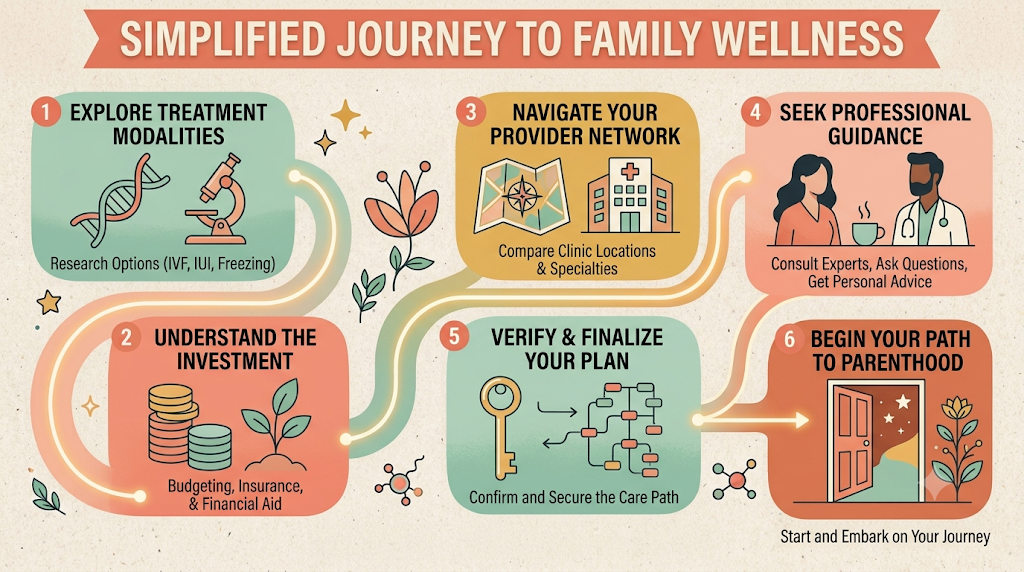
Research ──> Understand ──> Compare ──> Verify ──> Ask ──> Decide
- Research: Explore objective medical educational libraries, regulatory registries, and reputable health databases to understand standard procedures.
- Understand: Learn core clinical terminology, diagnostic benchmarks, and procedural differences before investigating specific providers.
- Compare: Evaluate multiple facilities side-by-side based on objective criteria such as laboratory accreditation, physician credentials, and transparent billing.
- Verify: Check clinic claims against independent medical boards, recognized registries, and verifiable fee structures.
- Ask: Compile focused, specific questions regarding individual medical history, itemized costs, and laboratory protocols for consultation appointments.
- Decide: Make thoughtful, personalized care choices collaboratively with qualified healthcare professionals.
A Practical Healthcare Provider Checklist
- [ ] Are the clinic’s physicians board-certified in reproductive endocrinology and infertility?
- [ ] Does the facility have on-site, accredited embryology and endocrine laboratories?
- [ ] Are the pricing sheets fully itemized, including medications, monitoring, anesthesia, and storage?
- [ ] How does the clinic calculate and define its published cycle outcome statistics?
- [ ] What are the daily operating hours and protocols for time-sensitive ultrasound monitoring?
- [ ] Is there an assigned clinical coordinator, and how are urgent after-hours questions handled?
- [ ] What emotional and psychological counseling resources are integrated into the clinic’s practice?
- [ ] Which specific clinical questions should be discussed during an initial physician consultation?
Objective Resources for Initial Exploration
Educational discovery platforms can streamline the preliminary stages of research by aggregating baseline data into an accessible, non-clinical format. An independent educational directory like IVFHospitalsNow.com helps users discover regional facilities, understand procedural breakdowns, and review general fee categories without promotional pressure. By utilizing neutral research tools alongside primary medical consultations, patients can approach reproductive care decisions with confidence, clarity, and objective information.
How should I compare IVF clinics?
Focus on physician board certifications, embryology laboratory accreditations, emergency communication practices, and transparent, itemized billing. Avoid relying solely on online patient reviews or uncontextualized promotional claims.
What factors can affect IVF treatment cost?
Total expenses vary based on prescribed medication protocols, preliminary diagnostic screenings, anesthesia fees, specialized laboratory procedures like micro-manipulation or biopsy, and recurring cryopreservation storage charges.
How should IVF success rates be interpreted?
Always evaluate the specific metric being reported, prioritizing live birth rates per intended retrieval over positive pregnancy test rates. Review outcomes stratified by specific age categories and underlying medical diagnoses.
What should I consider before researching treatment abroad?
Investigate local reproductive health laws, clinic accreditation standards, language accessibility with clinical staff, travel logistics, and arrangements for local medical monitoring before departure and after returning home.
What factors can affect egg freezing cost?
Expenses depend on stimulation medication dosages, outpatient retrieval facility fees, laboratory vitrification techniques, and ongoing annual storage charges over time, alongside eventual thawing and fertilization costs.
Conclusion
Navigating fertility care online requires a discerning, organized mindset. By familiarizing yourself with core clinical concepts, carefully analyzing financial breakdowns, verifying laboratory standards, and using transparent research tools, you can cut through digital noise. Thorough self-education serves as a strong foundation, equipping you to collaborate effectively with medical professionals who can tailor reproductive care to your unique personal circumstances.