Introduction
The Certified MLOps Architect certification validates your ability to design, deploy, and maintain production machine learning systems at scale. This guide is written for engineers and technical leaders who want to understand what this certification truly offers, how difficult it is, and whether it aligns with your career goals. Machine learning operations sits at the intersection of data engineering, DevOps, and model lifecycle management, and demand for skilled MLOps architects has grown rapidly across industries. We will explore the certification offered through aiopsschool, its structure, preparation strategies, and how it fits into modern engineering roles. This guide helps professionals make better career decisions based on real-world experience, not marketing claims.
What is the Certified MLOps Architect?
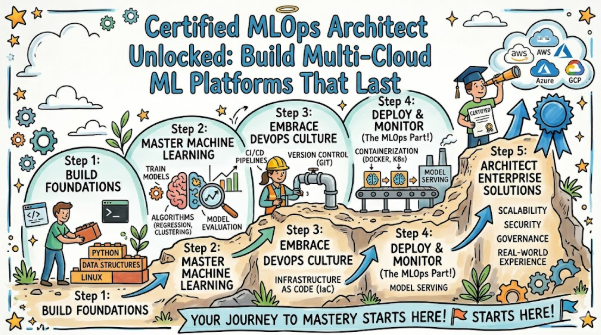
The Certified MLOps Architect represents a professional credential focused on production-ready machine learning systems rather than theoretical algorithms or data science alone. It exists because organizations struggle to move models from notebooks to reliable, scalable, and maintainable production environments. This certification emphasizes continuous integration and delivery for ML (CI/CD for ML), model monitoring, data validation, feature stores, and infrastructure as code applied to ML workloads. It aligns with modern engineering workflows where platform teams, data engineers, and DevOps professionals collaborate to operationalize artificial intelligence. The program tests practical knowledge of tools like Kubeflow, MLflow, TensorFlow Extended (TFX), and cloud ML platforms while reinforcing governance and reproducibility.
Who Should Pursue Certified MLOps Architect?
Working software engineers who already understand basic DevOps practices but want to specialize in machine learning infrastructure benefit most from this certification. Site reliability engineers supporting data-intensive applications, platform engineers building internal ML platforms, and cloud architects designing AI workloads will find direct relevance. Security professionals focused on model security and compliance (DevSecOps for ML) also gain valuable skills. In India, professionals in IT services, product companies, and AI startups increasingly need MLOps credentials to stand out in a crowded job market. Beginners with strong Linux and Python basics can pursue it after foundational DevOps certifications, while experienced engineers use it to validate advanced skills. Engineering managers benefit by understanding what their ML platform teams actually need to succeed.
Why Certified MLOps Architect is Valuable
The certification holds value because enterprise adoption of machine learning has moved beyond experimentation into production-critical systems. Banks, e-commerce platforms, healthcare providers, and manufacturing companies all need reliable ML pipelines that can run for months without degradation. Tools change rapidly, but the principles of model versioning, automated retraining, drift detection, and rollback strategies remain constant. This certification helps professionals stay relevant by teaching those enduring patterns rather than chasing every new framework. The return on time and career investment is high because MLOps roles command premium salaries globally and in India, with many organizations struggling to find candidates who understand both ML and production engineering.
Certified MLOps Architect Certification Overview
The program is delivered via Certified MLOps Architect and hosted on aiopsschool. The certification is structured as a single comprehensive credential covering the end-to-end MLOps lifecycle. Assessment includes a proctored online examination with multiple-choice questions, scenario-based problems, and practical design tasks. There is no mandatory training, though official course materials and labs are available. The certification ownership lies with the DevOps certification body associated with aiopsschool, known for practical, vendor-neutral credentials. The program typically requires 40-60 hours of dedicated study for experienced professionals, and the exam fee is competitive with other industry certifications.
Certified MLOps Architect Certification Tracks & Levels
The certification is offered at a single professional level that assumes foundational DevOps and basic ML knowledge. However, the curriculum includes three depth tracks within the main certification: Pipeline Engineering Track (focus on CI/CD for ML), Model Governance Track (focus on compliance and monitoring), and Infrastructure Track (focus on Kubernetes and cloud ML platforms). Foundation concepts cover MLOps principles and tool evaluation. The professional level requires hands-on project submission or case study analysis. Advanced aspirants can later pursue specialized add-ons in areas like LLMOps or MLOps for edge computing. This structure aligns with career progression from DevOps engineer to ML platform lead to architect.
Complete Certified MLOps Architect Certification Table
| Track | Level | Who it’s for | Prerequisites | Skills Covered | Recommended Order |
|---|---|---|---|---|---|
| MLOps Professional | Certified Architect | DevOps, Data, and Platform engineers with 2+ years experience | Basic Python, Docker, Git; Familiarity with ML concepts | ML pipeline design, Model versioning, Feature stores, Drift detection, CI/CD for ML, Kubeflow, MLflow | First and primary certification |
| MLOps Pipeline Engineering | Embedded in main | Engineers focusing on automation | Same as above | GitHub Actions for ML, Airflow, TFX pipeline components | After core concepts |
| Model Governance | Embedded in main | Security and compliance roles | Same plus basic compliance knowledge | Model cards, Explainability, Audit trails, GDPR for ML | After core concepts |
| Infrastructure for ML | Embedded in main | Platform and SRE roles | Kubernetes basics | KFServing, Seldon, GPU scheduling, Auto-scaling | After core concepts |
Detailed Guide for Each Certified MLOps Architect Certification
Certified MLOps Architect – Professional Level
What it is
This certification validates your ability to design and implement production ML systems that are reliable, scalable, and maintainable. It tests both conceptual knowledge and practical application of MLOps patterns.
Who should take it
DevOps engineers moving into ML workloads, data engineers who want to own the production side, platform engineers building internal ML platforms, and software engineers supporting data science teams. Experience level is intermediate to senior, typically two to five years in related roles.
Skills you’ll gain
- Designing ML pipelines with automated training, validation, and deployment
- Implementing model versioning and experiment tracking using MLflow or similar
- Setting up feature stores for training-serving consistency
- Detecting data drift and concept drift in production
- Building CI/CD pipelines for notebooks, models, and inference code
- Monitoring model performance metrics and system health
Real-world projects you should be able to do
- Deploy a scikit-learn model to production with A/B testing and automatic rollback
- Build a retraining pipeline that triggers when data drift exceeds a threshold
- Create a feature store that serves features for both training and inference
- Implement canary deployments for a TensorFlow model on Kubernetes
- Set up model monitoring dashboards with alerts for performance degradation
Preparation plan
- 7 to 14 days: Assess your current gaps. Take the official syllabus and identify weak areas. Set up a local environment with Docker and a cloud trial account. Complete one hands-on lab from each major topic (pipelines, monitoring, feature store).
- 30 days: Focus on deep practice. Build two complete end-to-end MLOps projects using different tool stacks (e.g., Kubeflow + MLflow, then TFX + Vertex AI). Take practice exams. Review MLOps design patterns from case studies.
- 60 days: Simulate exam conditions. Take three full-length practice tests. Rebuild a project you did earlier but add advanced features like explainability and model registry. Join study groups or forums to discuss tricky scenarios.
Common mistakes
Underestimating the need for hands-on practice with real ML models. Candidates often focus on theory but fail to debug actual pipeline failures. Another mistake is ignoring model monitoring and only focusing on deployment. Many forget to practice with different model frameworks (scikit-learn, XGBoost, TensorFlow). Skipping version control for data and models leads to confusion in design questions.
Best next certification after this
- Same-track option: Certified MLOps Architect – Advanced (if available) or LLMOps Specialist for generative AI pipelines.
- Cross-track option: Certified Kubernetes Administrator (CKA) or AWS Certified Machine Learning Specialty to broaden infrastructure or cloud ML skills.
- Leadership option: Certified Agile DevOps Leader or ITIL 4 for managing ML platform teams and governance processes.
Choose Your Learning Path
DevOps Path
If you come from a DevOps background, start by reinforcing your CI/CD knowledge with ML-specific twists. Learn how to test data and model code separately. Focus on pipeline orchestration using tools you already know like Jenkins or GitLab CI, then add MLflow and DVC. Your value lies in bringing production discipline to experimental ML work. Move from basic DevOps to MLOps Architect after six months of focused practice.
DevSecOps Path
Security professionals should emphasize model governance, vulnerability scanning for ML dependencies, and compliance automation. Learn to detect model poisoning, extract sensitive data from models, and implement model signing. This path leads to specialized roles in regulated industries like finance and healthcare. The Certified MLOps Architect gives you the vocabulary and design patterns to embed security into every stage of the ML lifecycle.
SRE Path
SREs will focus on reliability aspects of ML systems: latency SLOs for inference, model serving autoscaling, and canary analysis. Learn to measure model performance degradation as a service level indicator. Understand how retraining frequency affects system stability. This certification complements SRE skills by adding ML-specific failure modes like cold starts for large models and memory leaks in GPU pipelines.
AIOps / MLOps Path
For professionals already in AIOps or MLOps, this certification validates and structures your existing knowledge. It helps you fill gaps in areas like feature stores and model versioning. Use it to move from junior MLOps engineer to architect or lead. The certification also signals to employers that you follow industry best practices rather than ad-hoc solutions. Pair it with cloud ML certifications for maximum impact.
DataOps Path
Data engineers and DataOps practitioners should focus on the data validation, feature engineering, and data versioning aspects of MLOps. Learn how to apply data quality tests as part of pipeline gates. Understand the difference between batch and streaming feature computation. This certification helps you transition from traditional ETL to ML-focused data platforms where models consume features directly from production data pipelines.
FinOps Path
FinOps professionals can use MLOps certification to understand cost drivers in ML workloads: GPU instance selection, spot instance usage for training, and inference autoscaling. Learn to design pipelines that minimize cloud spend without sacrificing model quality. This path is valuable for cloud finance teams supporting AI initiatives. The certification provides enough technical depth to have credible conversations with engineering teams about ML cost optimization.
Role → Recommended Certified MLOps Architect Certifications
| Role | Recommended Certifications |
|---|---|
| DevOps Engineer | Certified MLOps Architect (Professional) first, then Kubernetes or cloud ML cert |
| SRE | Certified MLOps Architect plus Prometheus monitoring certification for ML metrics |
| Platform Engineer | Certified MLOps Architect with focus on Infrastructure track, then CKA |
| Cloud Engineer | Certified MLOps Architect plus AWS/Azure/GCP ML specialty |
| Security Engineer | Certified MLOps Architect with Model Governance track, then DevSecOps for ML |
| Data Engineer | Certified MLOps Architect with Data validation focus, then Data Engineering cert |
| FinOps Practitioner | Certified MLOps Architect (understanding cost design) plus FinOps Certified Practitioner |
| Engineering Manager | Certified MLOps Architect (overview level) plus team leadership or agile certification |
Next Certifications to Take After Certified MLOps Architect
Same Track Progression
Deepen your MLOps expertise with advanced topics like multi-cloud ML pipelines, real-time inference at scale, or large language model operations (LLMOps). Some providers offer specialized credentials in Kubeflow, Ray, or Feast. You can also pursue a mentor or trainer level certification if you want to teach others.
Cross-Track Expansion
Broaden your skills by adding cloud-specific ML certifications from AWS, Azure, or Google Cloud. Alternatively, learn data engineering deeply with a certification like Data Engineering Professional or Apache Spark certification. Understanding both ML platform and data platform makes you a stronger architect.
Leadership & Management Track
Transition to leadership by earning certifications in technical project management, value stream management, or team coaching. Certifications like Professional Scrum Master or SAFe Agilist help you lead MLOps teams effectively. Many architects move into director roles after adding these people-focused credentials.
Training & Certification Support Providers for Certified MLOps Architect
DevOpsSchool
DevOpsSchool offers instructor-led training programs specifically for the Certified MLOps Architect exam. Their courses include hands-on labs, recorded sessions, and practice exams aligned with the latest syllabus. Many learners appreciate the real-world case studies drawn from production ML deployments in banking and e-commerce. The training can be taken live online or in classroom settings across major Indian cities.
Cotocus
Cotocus provides practical, project-based coaching for professionals preparing for MLOps certification. They assign a dedicated mentor who reviews your pipeline designs and code. This is useful if you learn best through guided practice rather than self-study. Cotocus also offers corporate training packages for teams.
Scmgalaxy
Scmgalaxy focuses on community-driven learning with open source MLOps tools. They offer free study groups, recorded workshops, and peer review sessions for certification aspirants. The platform is particularly strong in Kubeflow and Argo workflows for ML. Scmgalaxy is a good supplement if you want to avoid expensive training.
BestDevOps
BestDevOps aggregates preparation resources including practice question banks, cheat sheets, and mock exam simulators. Their mobile-friendly platform helps you study in short bursts. They also maintain a blog with frequent updates on exam changes and new MLOps patterns.
devsecopsschool
devsecopsschool specializes in security-integrated MLOps training. They cover model scanning, secure model serving, and compliance automation for regulated industries. Their course is ideal for security engineers moving into ML governance roles.
sreschool
sreschool teaches MLOps from an SRE perspective, emphasizing SLIs, SLOs, error budgets for model inference, and incident response for ML failures. Their training includes real outage post-mortems from ML systems. This helps you prepare for operational scenarios beyond basic certification.
aiopsschool
aiopsschool is the official certification provider and offers the most authoritative preparation materials. They provide a detailed syllabus, reference architecture guides, and a candidate handbook. While they do not force you to take their training, the official self-paced course covers every exam objective with demos and quizzes.
dataopsschool
dataopsschool focuses on the intersection of DataOps and MLOps, particularly data validation, pipeline testing, and data lineage. Their training helps data engineers bridge the gap to ML workloads. They also cover feature stores in depth using open source tools.
finopsschool
finopsschool offers a unique perspective on cost-aware MLOps. Their training teaches you to design pipelines that track ML spend per experiment, choose cost-effective instance types, and implement auto-shutdown for idle training jobs. This is valuable for FinOps practitioners supporting AI teams.
Frequently Asked Questions (General)
1. How difficult is the Certified MLOps Architect exam compared to other DevOps certifications?
It is moderately difficult, requiring both theoretical knowledge and hands-on design skills. The exam is comparable to the Certified Kubernetes Administrator (CKA) in depth but covers a wider range of topics. Most experienced DevOps engineers need 40 to 60 hours of focused study.
2. What are the official prerequisites for taking this certification?
There are no mandatory prerequisites, but you should know Python, Docker, Git, and basic machine learning concepts like training, evaluation, and inference. Experience with any cloud platform and CI/CD tools is highly recommended.
3. How long does the certification remain valid?
The certification is valid for three years. You can renew by retaking the current exam or earning continuing education credits through approved training or conference attendance.
4. Can I take the exam online from home?
Yes, the exam is proctored online. You need a quiet room, a working webcam, and a reliable internet connection. The proctor will verify your environment before starting.
5. What is the exam format and duration?
The exam includes 60 to 80 questions, mixing multiple-choice, multiple-select, and scenario-based design problems. You have 120 minutes to complete it. Some questions require interpreting logs or pipeline diagrams.
6. Is there any hands-on lab component?
The main exam is theory and design based. However, a separate practical project submission may be required for the full architect title. Check the official syllabus for current requirements.
7. How much does the certification exam cost?
The exam fee is typically between 250 and 350 USD, depending on regional pricing. Discounts may be available for group bookings or during promotional periods. Retakes cost approximately 50 percent of the original fee.
8. What is the passing score?
You need to score at least 70 percent to pass. The exam does not penalize guessing, so answer every question. Some questions carry higher weight based on their complexity.
9. How soon do I get my results?
Results are available immediately after submission for multiple-choice sections. If a practical project is required, results take up to seven business days. You receive a digital certificate and a verification link.
10. Can I use the certification to get a job in India?
Yes, many Indian IT services companies (TCS, Infosys, Wipro) and product startups actively hire MLOps architects. The certification helps you stand out in a candidate pool where only a few have formal MLOps credentials.
11. What if I fail the exam? Can I retake it?
You can retake after 14 days. A third attempt requires a 30-day waiting period. There is no limit on total attempts, but each retake incurs a fee.
12. Is this certification vendor-neutral or specific to one cloud?
It is vendor-neutral, focusing on patterns and open source tools. You will learn concepts applicable to AWS SageMaker, Azure ML, Google Vertex AI, and on-premises Kubernetes clusters.
FAQs on Certified MLOps Architect
1. Does the Certified MLOps Architect require coding in the exam?
No, the exam does not require you to write code from scratch. However, you must be able to read and interpret Python, YAML, and shell script snippets to answer design and debugging questions.
2. How does this certification differ from a cloud vendor ML certification?
Cloud vendor certifications teach you specific services like SageMaker or Vertex AI. This certification teaches vendor-agnostic principles like model versioning, drift detection, and pipeline orchestration that work anywhere.
3. Can a data scientist without DevOps experience earn this certification?
It is possible but very challenging. Data scientists should first learn Docker, CI/CD basics, and infrastructure concepts. Plan for at least three months of preparation before attempting the exam.
4. What is the single most important topic to master for the exam?
End-to-end pipeline design, including how code, data, and models flow from development to production. Understand the interaction between experiment tracking, model registry, and deployment triggers.
5. Are there any free preparation resources available?
Yes, the official aiopsschool website provides a syllabus and sample questions. YouTube channels and community blogs offer free tutorials. However, comprehensive practice exams and hands-on labs often require paid access.
6. How often does the exam syllabus change?
The syllabus is reviewed annually and updated when major MLOps patterns shift. New tools or practices may be added, but core principles remain stable. Always check the official site for the latest version.
7. Will this certification help me transition from software engineering to MLOps?
Yes, it is one of the most direct paths. The certification teaches you the ML-specific extensions to your existing engineering skills. Many software engineers have made this switch within six months of earning the credential.
8. What is the job title after earning this certification?
Typical titles include MLOps Engineer, ML Platform Engineer, AI Infrastructure Architect, and Data Science Platform Lead. In smaller companies, you might be the sole person responsible for production ML.
Final Thoughts: Is Certified MLOps Architect Worth It?
If you are already working with DevOps or data platforms and want to move into the rapidly growing field of machine learning operations, this certification provides a structured, practical path forward. It is not an easy credential, but the effort pays off in both career opportunities and salary growth. The most honest advice is this: do not collect certifications for their own sake. Use the preparation process to build real projects you can show to employers. Build a model pipeline that retrains itself, a monitoring dashboard that catches drift, or a feature store that serves online predictions.
The certification exam will validate your knowledge, but your portfolio will get you hired. For engineers in India and globally, the Certified MLOps Architect offers a clear signal to employers that you can handle production ML, a skill still rare in the industry. If you commit to learning deeply and practicing consistently, this certification will accelerate your career. If you only want a badge without real understanding, skip it. The real value comes from what you can build after earning it.