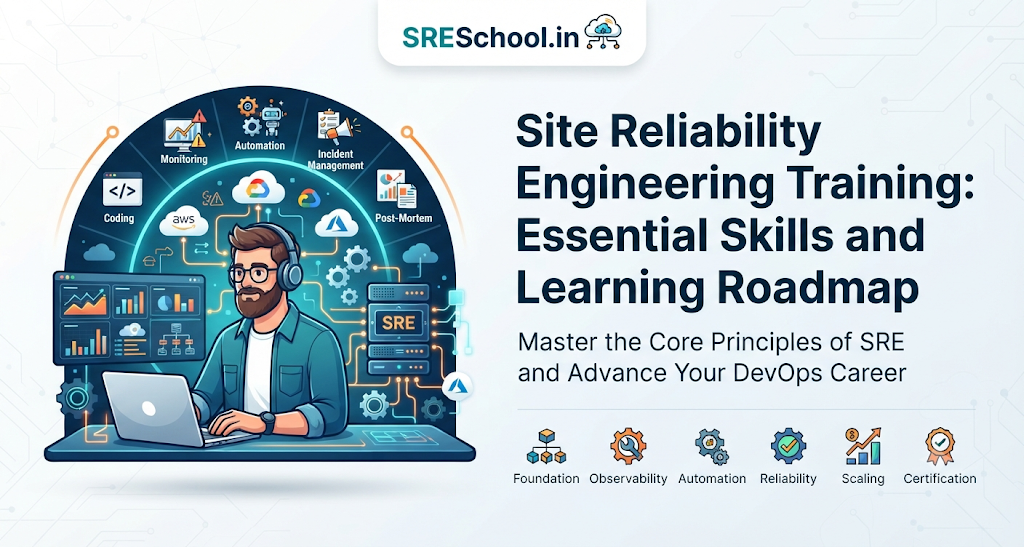
Introduction: Why Site Reliability Engineering Matters Today
Modern software systems run on complex cloud environments, distributed microservices, and automated delivery pipelines. When applications scale to millions of users, even a brief outage can result in severe financial loss and damaged customer trust. Organizations no longer rely solely on traditional system administration to keep production environments stable. Instead, they turn to Site Reliability Engineering to bridge the gap between software development and IT operations.
Site Reliability Engineering applies software engineering principles to infrastructure and operations problems. Rather than manually fixing servers when things break, reliability engineers write software and automation to manage systems safely at scale. This approach helps engineering teams balance the speed of new feature releases with the stability required by production users.
For many technical professionals, building a solid foundation in these practices requires structured learning. Exploring specialized SRE training, following a comprehensive SRE course, or preparing for an SRE certification allows engineers to transition successfully into high-impact roles. Platforms like SRESchool.in provide targeted learning resources designed to help practitioners master these critical production disciplines.
Core Principles of Site Reliability Engineering
Site Reliability Engineering changes how teams think about uptime, system performance, and operational risk. Instead of aiming for absolute perfection, SRE introduces practical frameworks to measure and manage reliability.
Understanding Service-Level Indicators (SLIs) and Service-Level Objectives (SLOs)
Reliability cannot be managed effectively if it is not measured accurately. SRE teams rely on quantitative metrics to understand how a system performs from the user’s perspective.
- Service-Level Indicators (SLIs): An SLI measures a specific aspect of service performance. Common examples include request latency, error rates, and system throughput. If a web service takes more than 300 milliseconds to respond, an SLI tracks the proportion of requests meeting that threshold.
- Service-Level Objectives (SLOs): An SLO sets a target for the SLI over a specific time window. For instance, an engineering team might establish an SLO stating that 99.9% of all successful API requests must return a response within 300 milliseconds over a rolling thirty-day period.
These metrics remove guesswork from system operations. They give developers and operations teams a shared language to discuss application health and performance bottlenecks.
Balancing Risk with Error Budgets
One of the most powerful concepts in Site Reliability Engineering is the error budget. An error budget represents the amount of unreliability a service is allowed to experience within a given period.
If an SLO specifies 99.9% availability, the error budget is 0.1%. This means the system can experience a small window of downtime or failed requests without violating the internal objective.
Error budgets align incentives between product development and operations. When the error budget is healthy, developers can release new features quickly. When stability drops and the error budget is exhausted, the team pauses new deployments to focus entirely on reliability, refactoring, and bug fixes. This mechanism transforms reliability from a constant source of friction into a shared operational lever.
Eliminating Toil Through Automation
Manual, repetitive, and automatable operational work is known as toil. Toil scales linearly with service growth: as a company adds more customers and infrastructure, manual support tasks consume more engineering hours.
Site Reliability Engineering treats operations as a software problem. If an engineer must manually restart a failed service, provision a database backup, or rotate security certificates every week, that task is a candidate for automation. By writing scripts, using configuration management tools, and building self-healing systems, teams reduce toil and free up engineers to work on high-value architectural improvements.
Essential SRE Tools and Technical Stack
Operating distributed production environments requires a robust toolchain. While processes and culture drive reliability, the right technology stack ensures visibility, speed, and safety.
Monitoring and Observability Platforms
Monitoring tells you when a system is broken, while observability helps you understand why it broke. Modern production systems are too complex for simple “up-or-down” ping checks. Comprehensive observability relies on three primary data types:
- Metrics: Numerical data collected over time, such as CPU utilization, memory consumption, and request rates.
- Logs: Timestamped text records of discrete events generated by applications and infrastructure components.
- Traces: Records of a request’s journey as it traverses multiple distributed microservices.
Tools in this category help teams detect anomalies early, debug latency spikes, and trace error propagation across complex cloud architectures.
Infrastructure as Code (IaC) and Configuration Management
Managing cloud resources manually through web consoles introduces human error and configuration drift. Infrastructure as Code allows engineers to define servers, networks, and storage components using declarative configuration files.
By storing infrastructure definitions in version control, teams can review changes through pull requests, test updates in staging environments, and replicate entire production environments in minutes. Configuration management tools further ensure that every server maintains a consistent, secure state throughout its lifecycle.
Container Orchestration and Cloud Platforms
Containerization has transformed how applications are packaged and deployed. Technologies like Kubernetes allow organizations to manage containerized workloads across clusters of cloud servers automatically. Kubernetes handles container scheduling, scaling, load balancing, and self-healing. Mastery of container orchestration and cloud infrastructure is a foundational requirement for any modern SRE engineer.
What to Look For in an Effective SRE Training Program
Professionals seeking to advance their careers often look for structured educational programs. A high-quality SRE training curriculum should bridge theoretical reliability concepts with practical, hands-on execution.
Core Curriculum Areas
An effective learning path covers multiple foundational and advanced domains:
- Foundational Linux and Networking: Understanding process management, TCP/IP networking, DNS resolution, and system performance tuning.
- SLI, SLO, and Error Budget Design: Learning how to define, measure, and govern system reliability metrics.
- Observability and Incident Management: Mastering metrics collection, log aggregation, alerting strategies, and structured post-incident reviews.
- Automation and Scripting: Developing proficiency in languages like Python or Go alongside modern CI/CD pipelines.
- Cloud Infrastructure and Kubernetes: Deploying, scaling, and troubleshooting distributed applications in cloud-native environments.
Hands-On Labs and Production Scenarios
Theory alone is not enough to prepare engineers for real-world production incidents. A strong SRE course incorporates realistic lab exercises, such as simulating network failures, debugging memory leaks in containerized applications, configuring automated alerts, and responding to staged outages. These practical exercises build the confidence needed to manage critical production systems under pressure.
Navigating SRE Certification and Career Growth
As organizations prioritize system resilience, demand for skilled reliability professionals continues to rise. Professionals often use structured certifications to validate their technical expertise and demonstrate commitment to the discipline.
Validating Knowledge Through SRE Certification
An industry-recognized SRE certification helps professionals prove their understanding of reliability principles, automation frameworks, and incident response workflows. While certification does not replace hands-on experience, it provides a structured roadmap for mastering complex technical domains. Preparing for an SRE certification encourages engineers to study essential topics systematically, from capacity planning to distributed systems troubleshooting.
Key Competencies for an SRE Engineer
An SRE engineer combines software development skills with system administration expertise. Important competencies include:
- Writing clean, maintainable automation scripts.
- Designing resilient, fault-tolerant cloud architectures.
- Analyzing system telemetry to identify performance bottlenecks.
- Conducting thorough root cause analysis after production incidents without placing blame.
- Collaborating with development teams to bake reliability into software from the design phase.
The Learning Ecosystem: SRE Training in India and Globally
The demand for reliable cloud infrastructure spans every global market, with a particularly vibrant technical community in India. Professionals across major technology hubs look for accessible, structured learning paths that fit their career goals.
Whether an engineer is transitioning from traditional system administration or upgrading software engineering skills, finding the right guidance is essential. Structured platforms like SRESchool.in support this journey by providing focused educational content, clear learning frameworks, and deep technical insights tailored to modern production engineering.
Frequently Asked Questions (FAQ)
What is the difference between DevOps and Site Reliability Engineering? DevOps focuses primarily on culture, collaboration, and streamlining the delivery pipeline from development to production. Site Reliability Engineering shares these goals but specifically applies software engineering to operational problems, focusing deeply on uptime, performance, error budgets, and incident response.
Do I need programming experience to learn SRE? Yes. Because SRE emphasizes automation and treating operations as a software problem, basic programming skills in languages like Python, Go, or Bash are essential for writing scripts, building tools, and maintaining infrastructure.
How do error budgets improve software development speed? Error budgets quantify the acceptable risk of failure. When an error budget is intact, development teams have the freedom to ship new features quickly. This removes bureaucratic delays and focuses discussions on data rather than fear of failure.
What background do most SRE engineers come from? SRE engineers come from diverse technical backgrounds, including software engineering, system administration, cloud engineering, network operations, and DevOps.
How does observability differ from traditional monitoring? Traditional monitoring tells you when a system is failing by tracking predefined thresholds. Observability allows you to inspect the internal state of a system by analyzing metrics, logs, and traces, helping you understand unexpected failures and novel issues.
What role does automation play in Site Reliability Engineering? Automation reduces manual, repetitive operational tasks known as toil. By automating provisioning, deployments, and remediation, engineers can focus on scaling systems and improving long-term reliability.
How can I start preparing for an SRE role? You can start by mastering Linux fundamentals, networking, containerization with Docker and Kubernetes, and basic infrastructure automation. Engaging in structured SRE training and exploring focused tutorials will help accelerate your learning path.
Why is incident management important in SRE? Effective incident management ensures rapid detection, structured triage, clear communication, and fast recovery during outages. It also supports continuous learning through blameless post-incident reviews.
Conclusion and Next Steps
Site Reliability Engineering has become a cornerstone of modern software delivery. By combining software engineering with infrastructure operations, organizations can build scalable, resilient systems that withstand the complexities of cloud environments. Mastering this discipline requires dedication, continuous learning, and hands-on practice with production tools.
Readers interested in building practical Site Reliability Engineering skills can explore relevant SRE training, courses, tutorials, and certification resources available through SRESchool.in. Taking a structured approach to learning reliability principles will help you navigate complex cloud environments and advance your engineering career with confidence.