Introduction
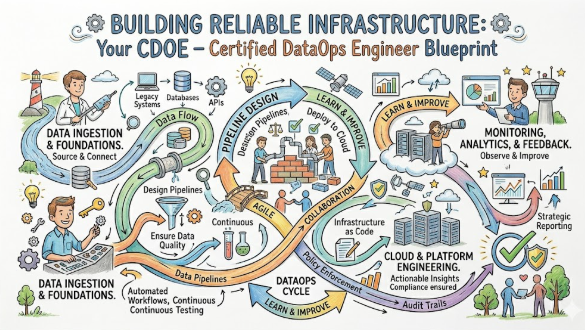
The modern data landscape is shifting rapidly, requiring engineering practices that match the velocity of cloud-native development. Traditional data engineering often suffers from siloed workflows, slow deployment cycles, and frequent pipeline failures. This comprehensive guide introduces the CDOE – Certified DataOps Engineer ecosystem, designed for software engineers, DevOps professionals, site reliability engineers, and data specialists who want to build resilient, automated data infrastructures. By applying proven DevOps and platform engineering principles to data workflows, this curriculum helps technical professionals eliminate operational bottlenecks and make informed career decisions in an increasingly data-driven market.
What is the CDOE – Certified DataOps Engineer?
The CDOE – Certified DataOps Engineer designation represents a production-focused validation of an engineer’s ability to orchestrate, automate, and secure continuous data delivery pipelines. It exists to bridge the widening gap between data science theory and reliable operational execution within enterprise environments. Unlike certifications that focus solely on isolated tool manipulation, this program emphasizes structural workflows, automated testing of data assets, version control for data schemas, and infrastructure as code. It aligns directly with modern enterprise workflows where data reliability, compliance, and rapid iteration are critical business requirements.
Who Should Pursue CDOE – Certified DataOps Engineer?
This certification program benefits software engineers, platform architects, cloud infrastructure specialists, and data engineers who want to specialize in high-throughput data systems. Beginners gain a structured methodology for building reliable systems, while experienced engineers use it to formalize their infrastructure expertise. Technical managers and architectural leaders can leverage the framework to build cross-functional teams that reduce data delivery cycle times. Whether managing infrastructure in regional technology hubs or global enterprise environments, this curriculum equips professionals to solve systemic data delivery problems.
Why CDOE – Certified DataOps Engineer is Valuable Today and Beyond
Enterprise adoption of distributed data systems has made ad-hoc pipeline management obsolete, driving immense long-term demand for automated data operations. This certification provides technical longevity by teaching architectural principles, feedback loops, and automation strategies that remain relevant even as specific tooling evolves. The return on investment is evident in minimized production downtime, predictable release cycles, and reduced cloud infrastructure expenditure. Professionals holding this credential demonstrate the rare ability to stabilize erratic data workflows and align technical performance with business objectives.
CDOE – Certified DataOps Engineer Certification Overview
The comprehensive educational program is delivered directly via CDOE – Certified DataOps Engineer, the platform that hosts the DataOpsSchool and practical laboratory assignments. The certification structures its assessment approach around real-world simulations, requiring candidates to build, troubleshoot, and optimize live data pipelines rather than merely memorizing theoretical terms. The entire ecosystem is owned and updated by industry practitioners to maintain strict alignment with current infrastructure practices. Candidates progress through clear educational checkpoints designed to validate both conceptual engineering clarity and practical execution capabilities.
CDOE – Certified DataOps Engineer Certification Tracks & Levels
The curriculum is structured across three distinct phases: foundation, professional, and advanced levels, allowing professionals to align their training with their current career stage. Specialized focus areas allow engineers to emphasize specific operational disciplines, such as combining data operations with site reliability engineering or automated security compliance. The foundational level establishes fundamental automated pipeline concepts, the professional track introduces complex multi-tier orchestrations, and the advanced tier focuses on enterprise-wide governance and global scale architecture. This tiered progression provides an explicit roadmap for shifting from tactical engineering tasks to strategic technical leadership.
Complete CDOE – Certified DataOps Engineer Certification Table
| Track | Level | Who it’s for | Prerequisites | Skills Covered | Recommended Order |
| Core DataOps | Foundation | Associate Engineers | Basic Linux & Python | Git, CI/CD Baselines, Containers | First |
| Pipeline Automation | Professional | DevOps & Data Engineers | Foundation Level | Orchestration, Data Testing, Observability | Second |
| Enterprise Architecture | Advanced | Principal Engineers & Leads | Professional Level | Data Governance, Multi-Region Scale, FinOps | Third |
Detailed Guide for Each CDOE – Certified DataOps Engineer Certification
CDOE – Certified DataOps Engineer – Foundation
What it is
This level validates a candidate’s core understanding of version control, continuous integration concepts, and containerization specifically applied to data engineering assets.
Who should take it
Junior software engineers, systems administrators, and entry-level data analysts looking to establish a disciplined baseline in modern automated workflows.
Skills you’ll gain
- Version control strategies for schema definitions and pipeline code.
- Automated build validation using continuous integration engines.
- Containerization of data processing scripts for environment consistency.
Real-world projects you should be able to do
- Package a Python-based data ingestion script into a reproducible container image.
- Configure a basic continuous integration pipeline that runs linting and syntax validation on SQL scripts.
Preparation plan
- 7 Days: Focus heavily on foundational command-line operations, basic version control commands, and understanding container runtimes.
- 30 Days: Complete all fundamental laboratory exercises and study how continuous integration environments execute isolated automation tasks.
- 60 Days: Review sample scenarios, practice building configurations from scratch, and eliminate dependencies on graphical interfaces.
Common mistakes
- Ignoring configuration management basics and hardcoding environmental variables within the pipeline configuration files.
- Skipping fundamental container networking exercises, leading to integration failures during live practical assessments.
Best next certification after this
- Same-track option: CDOE Professional Pipeline Automation
- Cross-track option: Cloud Infrastructure Fundamentals
- Leadership option: Technical Team Delivery Principles
CDOE – Certified DataOps Engineer – Professional
What it is
This certification confirms expertise in orchestrating complex multi-stage data pipelines, implementing automated data quality tests, and setting up deep observability platforms.
Who should take it
Mid-level DevOps specialists, data engineers, and platform engineers tasked with maintaining complex production data delivery systems.
Skills you’ll gain
- Dynamic orchestration of complex, multi-dependency data workflows.
- Implementation of automated statistical data quality gates within active pipelines.
- Distribution of centralized monitoring, logging, and tracing across distributed systems.
Real-world projects you should be able to do
- Construct an end-to-end automated orchestration pipeline that pauses and alerts when data volume drops below statistical thresholds.
- Deploy a centralized monitoring dashboard displaying real-time processing latency, error rates, and resource utilization metrics.
Preparation plan
- 7 Days: Deep dive into advanced orchestration logic, conditional execution strategies, and distributed logging mechanisms.
- 30 Days: Build multi-stage pipelines that simulate component failures to master automated recovery and alerting mechanisms.
- 60 Days: Conduct full-scale simulation exams, optimize pipeline execution speeds, and refine log aggregation queries.
Common mistakes
- Designing overly rigid orchestration workflows that fail catastrophically instead of degrading gracefully during network drops.
- Neglecting data freshness and accuracy metrics, focusing instead only on standard infrastructure resource metrics like CPU utilization.
Best next certification after this
- Same-track option: CDOE Advanced Enterprise Architecture
- Cross-track option: Site Reliability Engineering Practitioner
- Leadership option: Data Program Engineering Manager
CDOE – Certified DataOps Engineer – Advanced
What it is
This credential certifies a professional’s capacity to design enterprise-grade, highly secure, and cost-optimized data operations platforms operating at global scale.
Who should take it
Principal engineers, enterprise data architects, and technical directors responsible for organizational compliance, budgeting, and systems infrastructure.
Skills you’ll gain
- Architectural design for multi-region, high-availability data infrastructure platforms.
- Automated programmatic governance, access control compliance, and encryption audit logging.
- Strategic infrastructure cost optimization and algorithmic compute resource allocation.
Real-world projects you should be able to do
- Architect a global-scale data platform architecture incorporating automated region failover and automated data residency compliance checks.
- Implement a programmatic cost-governance framework that automatically scales down underutilized compute clusters based on historical patterns.
Preparation plan
- 7 Days: Analyze enterprise governance frameworks, cross-region networking architectures, and cryptographic identity compliance standards.
- 30 Days: Design and write infrastructure code configurations that deploy highly available, multi-tenant automated processing platforms.
- 60 Days: Refine architectural designs against strict compliance constraints and practice presenting technical solutions to engineering boards.
Common mistakes
- Over-engineering the foundational platform layers, resulting in excessive cloud infrastructure costs and maintenance complexity.
- Failing to incorporate comprehensive regulatory audit trails within automated compliance evaluation routines.
Best next certification after this
- Same-track option: Continuous Enterprise Infrastructure Evolution
- Cross-track option: Advanced Systems Security Architect
- Leadership option: Chief Technology Officer Strategy Track
Choose Your Learning Path
DevOps Path
This path focuses on adapting traditional continuous integration and continuous deployment methodologies to handle data assets. Engineers learn to treat database migrations, data schemas, and ingestion scripts with the same structural rigor applied to application source code. The training emphasizes minimizing release cycle times while maintaining absolute environmental consistency.
DevSecOps Path
Security must be woven into the fabric of data infrastructure, not treated as an afterthought. This trajectory instructs professionals on automating identity access management, scanning data definitions for sensitive patterns, and enforcing encryption at rest and in transit. Participants specialize in ensuring automated compliance with global data privacy regulations without slowing down the development lifecycle.
SRE Path
Reliability engineering applied to data systems ensures high availability and predictable system performance under heavy load. This pathway targets the mitigation of data pipeline failures, defining actionable service level objectives, and establishing resilient automated self-healing mechanisms. Engineers specialize in managing stateful systems, capacity planning, and establishing deep monitoring architectures.
AIOps Path
Modern environments generate massive operational telemetry datasets that require automated analysis. This specialisation covers the deployment of algorithmic models to identify anomalies within system infrastructure logs, predict potential hardware bottlenecks, and automate root-cause analysis routines. Engineers learn to manage the continuous feedback loops necessary to keep operations automated and intelligent.
MLOps Path
Deploying machine learning models requires specialized automation pipelines capable of managing code, architecture, and massive data lineage histories. This path trains engineers to build reproducible training environments, automate model validation steps, and orchestrate scalable inference delivery systems. The focus is on establishing continuous training loops that automatically update models safely in production.
DataOps Path
The core focus of this path is optimizing the collaboration, automation, and operational reliability of data delivery workflows across the enterprise. Professionals specialize in orchestrating varied data processing frameworks, building automated data validation checkpoints, and treating data pipelines as verifiable products. The curriculum targets the absolute reduction of data defects and pipeline downtime.
FinOps Path
Managing cloud expenditure requires deep financial accountability built directly into the engineering infrastructure layers. This specialization teaches professionals to track data processing expenses, allocate infrastructure costs to specific business units, and automate resource resizing policies. Engineers gain the ability to balance system performance with strict financial efficiency constraints.
Role → Recommended CDOE – Certified DataOps Engineer Certifications
| Role | Recommended Certifications |
| DevOps Engineer | CDOE Foundation, CDOE Professional |
| SRE | CDOE Professional, CDOE Advanced |
| Platform Engineer | CDOE Foundation, CDOE Professional, CDOE Advanced |
| Cloud Engineer | CDOE Foundation, CDOE Professional |
| Security Engineer | CDOE Professional, CDOE Advanced |
| Data Engineer | CDOE Foundation, CDOE Professional |
| FinOps Practitioner | CDOE Professional, CDOE Advanced |
| Engineering Manager | CDOE Foundation, CDOE Advanced |
Next Certifications to Take After CDOE – Certified DataOps Engineer
Same Track Progression
Upon completing the advanced tiers, engineers should pursue deep specialization certificates focused on specific distributed compute frameworks or complex cloud-native orchestration engines. This deepens technical authority within the data infrastructure domain.
Cross-Track Expansion
Professionals can broaden their operational footprint by acquiring certifications in advanced site reliability engineering methodologies or dedicated enterprise cloud security architecture programs. This turns a specialist into a highly resilient multi-disciplinary platform architect.
Leadership & Management Track
For engineers transitioning away from keyboard configuration tasks, the logical next step involves certifications in technology strategy, corporate financial engineering, or organizational team building. This bridges the gap between deep technical implementation and corporate business execution.
Training & Certification Support Providers for CDOE – Certified DataOps Engineer
DevOpsSchool provides comprehensive instructor-led virtual bootcamps and deeply structured practical laboratories designed to help working engineers master the core principles of continuous pipeline delivery and architectural infrastructure management.
Cotocus specializes in delivering custom enterprise-grade training solutions, focusing heavily on migrating legacy operations into containerized environments, implementing automated deployment strategies, and establishing modern platform configurations.
Scmgalaxy offers an extensive community-driven repository of technical tutorials, configuration templates, and collaborative study groups focused on version control strategies, automation orchestration tools, and continuous integration execution blueprints.
BestDevOps focuses its educational programs on the pragmatic execution of site reliability workflows, teaching professionals how to establish measurable service level indicators and build automated system recovery structures.
devsecopsschool centers its entire curriculum around the automated integration of security verification tools directly inside deployment pipelines, ensuring that vulnerability scanning and compliance checks happen programmatically.
sreschool provides targeted training programs designed to master the complexities of stateful distributed systems, cloud infrastructure performance scaling, rapid incident response workflows, and comprehensive telemetry aggregation.
aiopsschool teaches engineering teams how to apply advanced analytics and machine learning methodologies to massive operational datasets, enabling automated anomaly detection and predictive platform scaling architectures.
dataopsschool serves as the primary hub for specialized data operations education, delivering the official curricula, verified certification pathways, and production-grade laboratory simulations required for modern infrastructure mastery.
finopsschool delivers specialized training focused entirely on cloud financial management, cloud cost visibility, and building automated engineering frameworks that maximize corporate infrastructure efficiency.
Frequently Asked Questions (General)
- What are the foundational prerequisites for entering this specialized engineering program? Candidates need a functional baseline in Linux systems administration, a solid understanding of version control fundamentals with Git, and basic scripting competency in a language like Python.
- How long does it typically take an engineering professional to prepare for the certification exams? Preparation times vary based on historical experience, but most working professionals successfully complete the curriculum within thirty to sixty days of disciplined, structured study.
- Are the examinations theoretical multiple-choice tests or practical hands-on challenges?
The examination methodologies place heavy emphasis on practical, performance-based live laboratory simulations where candidates must resolve architectural faults and build automated assets. - Does this training program focus exclusively on a single proprietary cloud vendor ecosystem?
No, the educational content emphasizes cloud-agnostic architectural patterns and open-source tooling standards, ensuring the acquired skills transfer seamlessly across any cloud environment. - How does this certification directly impact an engineer’s daily operational workflows?
It provides a structured playbook for eliminating manual environment configuration tasks, reducing pipeline deployment failures, and establishing clear operational visibility across complex infrastructure deployments. - Is there an expiration date or renewal requirement attached to these credentials?
To ensure professionals remain current with rapidly changing technological standards, certifications require periodic renewal or proof of ongoing continuing engineering education credits. - Can a technical manager benefit from this curriculum without writing code daily?
Yes, the foundational and advanced tracks provide engineering leaders with the precise vocabulary, structural metrics, and strategic architectural insights required to build high-performing engineering teams. - What specific types of laboratory environments are provided during the training phase?
Students receive access to isolated, cloud-native sandboxes pre-configured with industry-standard orchestration tools, distributed databases, and automated testing engines. - How does this program address the concepts of infrastructure as code within pipelines?
Infrastructure automation is treated as a fundamental requirement throughout the curriculum, teaching candidates to define infrastructure components programmatically and manage them via code repositories. - What strategy does the exam use to grade the practical implementation tasks?
Automated grading scripts evaluate the functional state, security postures, efficiency metrics, and structural correctness of the live infrastructure configurations built by the candidate. - Are there active community forums available for peer-to-peer engineering support?
Yes, registration provides entry into verified digital communities where practitioners collaborate on architectural problems, share configuration solutions, and discuss industry developments. - Can enterprise organizations request customized training cohorts for internal engineering teams? Enterprise delivery partners offer tailored training frameworks designed to map directly onto an organization’s specific internal tooling choices and unique operational constraints.
FAQs on CDOE – Certified DataOps Engineer
- How does the CDOE – Certified DataOps Engineer certification differ from standard, non-specialized DevOps training tracks?
Standard tracks focus primarily on stateless application deployments, web server configurations, and traditional microservices architecture. This specialized program directly confronts the unique complexities of stateful data architectures, schema migrations, data lineage preservation, and massive analytical processing pipeline orchestration under strict data governance policies. - What specific open-source orchestration engines and processing frameworks are covered within the practical syllabus?
The curriculum provides comprehensive hands-on exposure to mainstream workflow orchestrators, data validation frameworks, and distributed processing engines. Rather than emphasizing a single tool, it teaches candidates the underlying architectural patterns common to all major industry engines used for data transportation and validation. - How does obtaining this credential improve an engineer’s marketability in competitive global talent pools?
Enterprises are aggressively seeking professionals who can transform unpredictable data pipelines into stable, automated infrastructure platforms. This certification proves to global employers that you possess the specialized skills to reduce data processing errors, optimize expensive cloud compute resources, and secure sensitive corporate assets. - What is the exact passing threshold and structural format of the professional-level examination?
The examination consists of a time-bound practical challenge conducted within a live, isolated cloud native environment. Candidates must successfully resolve architectural faults, write automated testing configurations, and optimize data pipeline execution speeds to meet strict target service level agreements defined in the prompt. - Does the curriculum address the complexities of managing database migrations inside automated deployment streams?
Yes, handling database schema evolutions without causing production downtime or data corruption is a core pillar of the professional track. The training teaches strategies for automated rollback testing, schema versioning, and blue-green database deployment patterns. - How does the advanced tier prepare engineers to deal with international data privacy laws and compliance frameworks?
The advanced level includes deep modules on programmatic data governance. It trains architects to build automated compliance checks into data streams, ensuring sensitive data is masked, access logs are indelibly recorded, and data residency requirements are respected globally. - Can these certifications be mapped directly onto internal engineering career ladders at the enterprise level?
Organizations frequently use this explicit three-tiered structure to design clear internal advancement pathways for their platform engineering teams, ensuring objective technical metrics govern promotion from associate to principal roles. - What structural support mechanisms exist if a candidate fails the practical certification exam on their first attempt?
Unsuccessful candidates receive a detailed performance breakdown highlighting specific structural weaknesses. They can leverage focused laboratory reviews, office-hour mentoring sessions, and community support channels before scheduling a supervised re-examination window.
Final Thoughts: Is CDOE – Certified DataOps Engineer Worth It?
Investing time and professional energy into technical certifications requires careful consideration of real-world career impact. The CDOE – Certified DataOps Engineer program avoids marketing hype, delivering instead a rigorous, hands-on framework that addresses the core realities of modern data infrastructure management. For engineers who want to escape ad-hoc fire-fighting and build highly automated, scalable data systems, this curriculum provides the exact architectural blueprints and engineering discipline required to excel. It is a practical, experience-driven career investment designed for professionals committed to mastering the intersection of data engineering and cloud-native operations.