Introduction
Every mobile connection relies on a quiet digital handshake. Whether an autonomous telematics tracker logs telemetry from an industrial port or a smartphone registers on an overseas cellular network, the connecting device must identify the carrier transmitting the signal. This identification does not start with a brand logo or a commercial website. It begins with standardized numeric identifiers programmed into the subscriber identity module and broadcast across regional radio cells.
Understanding these numeric identifiers is critical for network engineers, IoT developers, security researchers, and enterprise procurement teams. Mobile network identification determines roaming authorization, billing reconciliation, routing logic, and device provisioning. Yet, cross-referencing these numbers against operating entities is rarely straightforward. Network codes change through corporate acquisitions, spectrum reallocations, and regulatory updates.
Navigating this data ecosystem requires structured research, clear distinctions between regulatory assignments and retail services, and access to verified technical records.
The Core Identifiers Behind Cellular Connections
Cellular networks identify administrative boundaries using international numbering plans established by global standards bodies. The foundational standard governing terrestrial mobile network identification is Recommendation E.212, maintained by the International Telecommunication Union Telecommunication Standardization Sector (ITU-T).
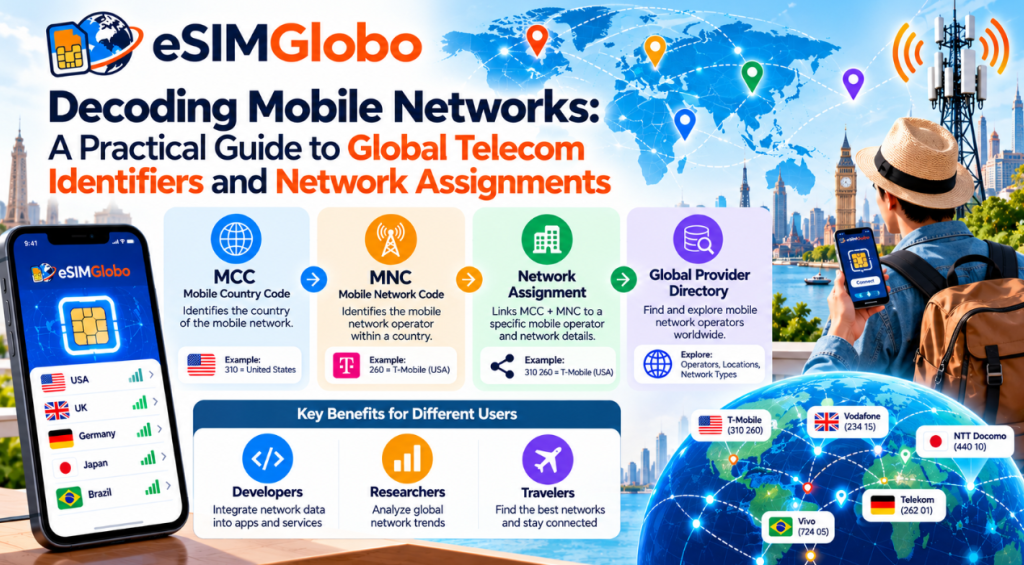
The International Mobile Subscriber Identity (IMSI) consists of two main sections: the Public Land Mobile Network (PLMN) identity and the Mobile Subscription Identification Number (MSIN). Within that PLMN segment, the first three digits represent the Mobile Country Code (MCC), followed by a two- or three-digit Mobile Network Code (MNC), while the remaining digits form the individual subscriber identifier.
What a Mobile Country Code (MCC) Represents
The Mobile Country Code is a three-digit numeric sequence. Its primary purpose is identifying a specific country, geographic area, or global satellite network. For instance, ITU allocation tables assign codes beginning with the digit 3 to North America and the Caribbean, while 4 and 5 denote parts of Asia and Oceania.
A Mobile Country Code does not align with an international telephone dialling code (ITU-T E.164). For example, while the United Kingdom uses the telephone calling prefix +44, its mobile networks operate under E.212 country codes ranging from 234 to 235. An MCC provides the geographic anchor within international mobile subscriber identities.
What a Mobile Network Code (MNC) Represents
The Mobile Network Code is a two- or three-digit sequence assigned by a national telecommunications regulator or numbering authority. When appended to an MCC, the MNC identifies a specific administrative network within that jurisdiction.
The length of the MNC depends on regional numbering plans:
- European networks primarily utilize two-digit MNC formats.
- North American systems standardized under the North American Numbering Plan typically allocate three-digit MNC values.
- Some administrations manage both formats simultaneously, requiring network elements to parse the full identifier cleanly without truncating leading zeros.
How MCC and MNC Form the PLMN Identity
Concatenating the Mobile Country Code and the Mobile Network Code produces a single operational value: the Public Land Mobile Network (PLMN) code. This numeric string forms the initial portion of every International Mobile Subscriber Identity (IMSI) stored on a SIM or embedded SIM profile.
When an administrative team conducts an MCC MNC Lookup, they translate this combined numeric string into the legal name of the organization holding the official assignment. This verification helps confirm whether an incoming signal matches an authorized carrier or an unknown transmitter.
Numbering Plans Versus Active Radio Infrastructure
An assigned code does not automatically prove that physical cell towers are currently transmitting radio frequencies. National regulators often allocate numbering blocks for administrative planning, experimental testing, or regional utility monitoring long before commercial networks go live.
Similarly, an entity may retain an assignment after decommissioning a legacy 2G or 3G core. Treating an administrative record as proof of commercial cellular coverage leads to integration bugs in automated IoT deployments.
Tracing the Operator Behind a Network Code
Interpreting technical identifiers requires systematically mapping raw numbers to verified corporate entities.
Incoming Numeric String (e.g., 208-01)
                   │
                   ▼
       [ Parsing & Normalization ]
    Isolate MCC (208) and MNC (01)
                   │
                   ▼
  [ Cross-Reference Regulatory Registry ]
    Query National Authority (e.g., ARCEP)
                   │
                   ▼
    [ Validate PLMN Code Lookup ]
  Confirm Legal Entity: Orange S.A.
                   │
                   ▼
 [ Cross-Check Operational Boundaries ]
  Distinguish Infrastructure Owner from
        Commercial Reseller/MVNO
Performing a reliable PLMN Code Lookup involves cross-referencing three distinct layers of telecom metadata:
| Investigation Layer | Primary Data Verified | Authoritative Sources |
| Regulatory Registry | Legal assignee name, allocation status, grant date | National regulators (e.g., FCC, BNetzA, ARCEP), ITU-T operational bulletins |
| Technical Allocation | MNC character length, operational status, network type | Carrier interconnect agreements, GSMA network registries |
| Commercial Relationship | Retail trading brand, wholesale access paths, operating MVNOs | Corporate disclosures, spectrum auction records, wholesale contracts |
Connecting an identifier to an organization requires checking the source date of the reference record. Telecom mergers, spectrum transfers, and bankruptcies frequently alter corporate custody of assigned blocks. When a provider acquires a competitor, the acquiring firm may route traffic through the acquired entity’s legacy network code for years to avoid recalling millions of distributed SIM cards.
A structured Mobile Network Operator Directory helps telecom analysts connect raw assignment records directly with the corporate structures responsible for those allocations. Transparent records document the date the entry was validated and cite the public filing that authorized the assignment.
Geographic Organization of Telecom Numbering
Mobile numbering plans follow regional and jurisdictional guidelines. Because radio spectrum is managed by national governments, code allocations reflect political borders, bilateral spectrum treaties, and administrative arrangements.
ITU-T Recommendation E.212
  ├── Geographic Codes (World Zones: 2xx Europe, 3xx North America, 4xx/5xx Asia/Oceania)
  └── Non-Geographic Codes (Shared Codes: 901 International Networks, 902 Maritime/Aeronautical)
Analyzing Mobile Network Codes by Country allows technical teams to understand the distribution of network ownership in specific target markets. Regional numbering dynamics reveal clear patterns:
- Large Markets with Dual Standards: In jurisdictions like the United States, hundreds of regulatory codes exist due to a combination of nationwide carriers, regional rural co-ops, and municipal infrastructure providers.
- Special Jurisdictions: Overseas territories and dependencies often receive distinct country codes despite their constitutional ties to a sovereign mainland state. Puerto Rico, for instance, uses the North American E.164 country calling code
+1, but its networks utilize E.212 identifiers such as330rather than the mainland United States codes (310through316). - Non-Geographic Allocations: The ITU maintains international allocations under shared prefixes like
901. These non-geographic codes belong to international maritime vessels, global satellite constellations, disaster-response units, and specialized cross-border IoT platforms.
Consulting an up-to-date Mobile Country Code List provides the baseline geographic boundaries needed to parse subscriber data correctly. Software systems that assume every cellular identifier maps neatly to a standard ISO-3166 sovereign country code often fail when handling cross-border networks, maritime vessels, or international roaming cores.
Understanding Operators, Virtual Operators, and Brands
A common source of confusion in telecommunications research is the difference between a network infrastructure owner, a legal assignee, and a customer-facing brand. A consumer might purchase cellular service from an enterprise whose name does not appear anywhere in national regulatory filings.
+---------------------------------------------------------------------------------------+
|                              Physical Infrastructure Layer                            |
|             Base Transceiver Stations, Radio Access Network (RAN), Towers             |
|                        Operated by Mobile Network Operator (MNO)                      |
+---------------------------------------------------------------------------------------+
                                           │
                         [Wholesale Interconnect Access]
                                           │
                                           ▼
+---------------------------------------------------------------------------------------+
|                               Virtual Operations Layer                                |
|          Mobile Virtual Network Operator (MVNO) / Core Network Aggregator             |
|                    May own Home Location Register (HLR/HSS) or billing                |
+---------------------------------------------------------------------------------------+
                                           │
                           [White-Label / Resale Delivery]
                                           │
                                           ▼
+---------------------------------------------------------------------------------------+
|                               Retail & Connectivity Brands                            |
|                 Consumer eSIM Apps, Travel Marketplaces, B2B Resellers                |
+---------------------------------------------------------------------------------------+
Mobile Network Operators (MNOs)
A Mobile Network Operator owns or controls the licensed radio spectrum, radio access network (RAN) hardware, and physical switching core required to deliver wireless services. MNOs are the direct assignees of primary network identifiers in national registries.
Mobile Virtual Network Operators (MVNOs)
A Mobile Virtual Network Operator offers cellular services without owning its own radio access network. MVNOs negotiate wholesale agreements with host MNOs to transmit traffic across physical infrastructure.
Virtual network operators adopt various deployment architectures:
- Full MVNOs: Deploy their own Mobile Switching Centers, Home Subscriber Servers (HSS), and packet gateways. These operators often secure their own distinct network codes from regulators, operating their core networks much like traditional carriers.
- Light or Thin MVNOs: Rely primarily on the host network’s core technical components, focusing their internal operations on billing, marketing, customer care, and retail distribution. They transmit the host carrier’s network code directly.
Because virtual operator structures vary significantly, an MVNO Directory helps connectivity researchers distinguish independent network cores from simple white-label brands. These records clarify whether a virtual operator maintains dedicated switching equipment or functions as a reseller.
Retail Connectivity and Travel Brands
Modern cellular marketplaces introduce an additional commercial layer. Third-party providers often sell digital connectivity without operating a technical core. These companies purchase wholesale data allowances from aggregators or MVNOs and distribute them to end users.
Tracing network operations requires looking through the retail marketing layer to identify the underlying network infrastructure provider.
Structuring Telecom Records for Research and Verification
Raw telecommunications data is often fragmented across hundreds of government gazettes, international notices, regulatory filings, and corporate disclosures. Transforming this disparate information into structured records requires clear technical definitions and systematic data maintenance.
A reliable Telecom Operator Database organizes technical identifiers using strict data standards:
- Consistent Identifier Formats: Every assignment record must distinguish between two- and three-digit network codes, preserving leading zeros without converting numerical fields into altered integers.
- Verifiable Source Trails: High-quality entries link directly to official numbering plans, public regulatory filings, or carrier announcements.
- Verification Status and Audit Dates: Network data becomes obsolete as spectrum licenses trade hands. Records must document when an assignment was last verified.
- Clear Categorization of Operational Status: Telecom databases must clearly separate active, commercial allocations from withdrawn, reserved, or experimental blocks.
Data quality directly impacts systems that rely on telecommunications intelligence for network operations, billing verification, and threat mitigation. Incomplete or poorly organized databases often confuse historic allocations with active commercial carriers.
The Digital Shift: Researching the eSIM Ecosystem
The rollout of GSMA-compliant embedded SIMs (eSIM) and remote SIM provisioning architectures has significantly changed how consumers and enterprise systems access cellular networks. Rather than swapping physical plastic cards, users install digital subscriber profiles via an over-the-air payload.
+-----------------------------------------------------------------------------------------+
|                              Remote SIM Provisioning (RSP)                              |
+------------------------------+---------------------------+------------------------------+
|       Subscription           |        Data Routing       |           Network            |
|       Configuration          |        Architecture       |          Validation          |
+------------------------------+---------------------------+------------------------------+
| SM-DP+ (Subscription Manager | Traffic often egresses    | Device checks local MCC/MNC; |
| Data Preparation) deploys    | via regional data centers | local roaming agreement      |
| digital profile to eUICC     | rather than local towers  | authorizes registration      |
+------------------------------+---------------------------+------------------------------+
When evaluating digital connectivity solutions, researchers must look beyond marketing claims and evaluate technical service specifications:
- Supported Destinations and Network Partners: Does the digital profile access primary national carriers directly, or does it route traffic through high-latency third-party roaming hubs?
- Profile Architecture: Does the profile use a single IMSI profile with wide roaming privileges, or does it support multi-IMSI switching depending on the connection point?
- Data Routing and Latency: Because travel profiles often egress data through regional home-routing proxies (such as routing North American traffic through a European core), real-world latency can vary substantially.
As the industry develops, an eSIM Provider Directory can help users investigate connectivity businesses, their supported destinations, technical profiles, and partner networks. While comprehensive directories for digital profiles continue to evolve alongside emerging GSMA standards, distinguishing between commercial plan distributors and underlying network operators remains essential.
Programmatic Telecom Intelligence: Developer Workflows
Modern software applications increasingly require programmatic access to mobile network identifiers to automate operational workflows.
       [ Client Application ]
    (Fraud Prevention / Logistics)
                 │
                 │ JSON Payload: IMSI / Carrier Signal
                 ▼
+-------------------------------------------------+
|       Telecom Identifier Resolution Layer       |
+-------------------------------------------------+
|  * Validates MCC format (3 digits)              |
|  * Normalizes MNC to prevent truncated zeroes   |
|  * Cross-references regulatory assignment data  |
|  * Checks allocation validity & entity status   |
+-------------------------------------------------+
                 │
                 ▼
[ Enriched Intelligence: Assignee Name, Origin, Status ]
Software engineers, data analysts, and telecom developers integrate network intelligence across several core use cases:
- Telecom Data Enrichment: Enriching internal telemetry records by translating raw IMSI values into structured network names and geographic regions.
- Fraud Prevention and Identity Verification: Cross-referencing incoming carrier signals with known numbering assignments to identify abnormal routing paths, SIM-farm operations, or unauthorized SMS hubs.
- IoT Logistics Management: Ensuring global tracking hardware successfully negotiates local connectivity agreements without attempting connection to unsupported or retired network codes.
- Routing Optimization: Guiding real-time traffic switches to route voice, data, or messaging packets across the most efficient carrier path.
In production environments, an MCC MNC Lookup API allows applications to query structured network assignments automatically, eliminating the need to manually parse regulatory gazettes. While developers often explore programmatic options, they must verify whether an external interface provides real-time access or structured reference data, ensuring the data schema matches their production requirements.
Navigating Data Limitations and Sourcing Realities
Interpreting telecommunications data requires recognizing the technical limits of administrative numbering records. Numbering assignments provide formal regulatory context, but they do not capture every operational detail of a live radio network.
Operational Divergence
A regulatory authority might assign an MCC-MNC combination to a regional carrier that subsequently defers its commercial network deployment. Software that treats an official assignment as an active, reachable network will encounter registration timeouts and routing errors.
Corporate Reorganization
Telecom carriers frequently merge, acquire regional spectrum blocks, or reorganize under holding companies. Regulatory filings often lag behind commercial rebranding by months or even years. As a result, an assignment record may list a legacy corporate entity long after retail operations have adopted a new brand.
Numbering Portability Exceptions
In regions with Mobile Number Portability (MNP), the telephone number dialled by an end user no longer indicates the terminating radio network. While Mobile Country Codes and Mobile Network Codes securely identify the physical subscriber profile inside the handset, they cannot be inferred solely from a customer-facing telephone number.
Practical Verification Checklist
When evaluating network assignment data for research or system design:
- Verify the Source Date: Confirm when the regulatory authority or database last validated the assignment.
- Review the Primary Registry: Check national regulator databases (such as the FCC, BNetzA, or OFCOM) when evaluating critical infrastructure paths.
- Check the MNC Length: Ensure software systems do not strip leading zeros from two- or three-digit network codes.
- Separate Brand from Assignee: Distinguish the marketing brand on a SIM card from the legal entity holding the technical assignment.
- Confirm Physical Radio Deployment: Cross-reference numbering records against spectrum licenses and broadcast station filings to confirm actual transmission status.
Researching Global Telecom Data with eSIMGlobo
Discovering, cross-referencing, and understanding international telecommunications data often means sifting through fragmented regulatory websites and inconsistent carrier disclosures.
eSIMGlobo addresses this challenge by providing an independent, structured directory of mobile network identifiers, carrier records, and verified network assignments. The platform helps developers, researchers, and telecom professionals analyze connectivity records without navigating difficult regulatory filings.
+-------------------------------------------------------------------------------+
|                       eSIMGlobo Technical Directory                           |
+-------------------------------------------------------------------------------+
|  * Standardized MCC and MNC Lookups                                           |
|  * PLMN Identification Records                                                |
|  * Sourced Network Operator Allocations                                       |
|  * Regional and Country-Level Assignment Views                                |
|  * Documented Verification Status and Audit Trails                            |
+-------------------------------------------------------------------------------+
The platform’s current directory tools allow researchers to look up mobile country codes, examine mobile network codes, and connect technical allocations to their official assignees. By referencing standard frameworks such as ITU-T Recommendation E.212 alongside national registry data, the platform helps users trace the organizations behind specific network codes.
As international connectivity changes, eSIMGlobo is expanding its research platform. The site’s product roadmap includes plans for dedicated virtual operator catalogs, an expanded directory for eSIM services, and direct developer access via structured data lookup services.
By focusing on verified sources and clear operational records, eSIMGlobo provides an accessible, transparent reference tool for analyzing the networks that power global communication.
Frequently Asked Questions
What is the difference between an MCC and an MNC?
A Mobile Country Code (MCC) is a three-digit number identifying a country, geographic territory, or global satellite network. A Mobile Network Code (MNC) is a two- or three-digit number that identifies a specific administrative carrier within that country. Together, they form a unique network identifier.
How does an MCC and MNC combination create a PLMN code?
Concatenating the MCC and MNC values creates the Public Land Mobile Network (PLMN) code. For example, combining MCC 208 (France) and MNC 01 (Orange) yields the PLMN identifier 20801. This identifier appears at the start of International Mobile Subscriber Identities (IMSIs) associated with that network.
Does a valid network code guarantee active cellular coverage?
No. An assignment record simply confirms that a national regulator allocated that code to an organization. It does not prove that the carrier has built out physical cell towers, is currently broadcasting radio signals, or offers retail connectivity in that area.
Why do some Mobile Network Codes have three digits while others have two?
The length of an MNC is determined by national numbering plans. Many European countries use two-digit codes, whereas the United States, Canada, and parts of Latin America use three-digit formats. System parsers must support both formats to avoid corrupting leading zeros.
How does a Mobile Network Operator differ from an MVNO?
A Mobile Network Operator (MNO) holds licensed radio spectrum and owns the physical radio transmission infrastructure. A Mobile Virtual Network Operator (MVNO) purchases wholesale network capacity from an MNO to provide cellular services, sometimes running its own switching core.
Can consumer brands offer mobile services without owning network infrastructure?
Yes. Many retail providers, travel connectivity apps, and digital platforms operate as MVNOs, resellers, or wholesale partners. They deliver connectivity services to end users while routing traffic over physical infrastructure maintained by partner carriers.
How do virtual SIMs and travel profiles connect to foreign networks?
Digital profiles rely on the same GSMA-standard authentication protocols as physical SIMs. They connect to foreign networks through international roaming agreements, authenticating against a home network core before registering on a local carrier’s cell tower.
Why do telecom mergers create confusing network records?
When carriers merge or acquire spectrum, updating network codes across millions of active devices is expensive and operationally difficult. Operators often maintain legacy network codes indefinitely, meaning an older assignment may route traffic to a newly branded parent company.
How do developers use mobile network assignment data?
Developers integrate mobile network data into applications to validate subscriber routing, detect potential telecommunications fraud, enrich device telemetry records, and ensure industrial IoT devices connect only to approved network partners.
Where does authoritative mobile network identification data come from?
Primary records originate from the International Telecommunication Union (ITU), particularly operational bulletins following Recommendation E.212, and national regulatory bodies like the FCC in the United States, ARCEP in France, and BNetzA in Germany.
Conclusion
Mobile telecommunications networks rely on standardized, structured numbering systems to manage global wireless communication. From individual consumer roaming connections to enterprise IoT fleets, identifiers like the Mobile Country Code, Mobile Network Code, and combined PLMN strings provide the technical foundation for device authentication, signal routing, and commercial interconnects.
Making sense of this ecosystem requires looking past marketing brands to examine underlying regulatory allocations. Tracing technical codes back to their primary sources, confirming when records were last updated, and understanding the differences between physical infrastructure owners and virtual resellers helps teams avoid costly operational assumptions.
As the industry adopts software-driven connectivity models, access to clear, well-structured network intelligence is more important than ever. Independent directories like eSIMGlobo help researchers, engineers, and technology businesses navigate this complex technical landscape, offering the verified records and structural transparency needed to understand modern global connectivity.