Introduction
Modern organizations rely heavily on data to drive decision-making, power machine learning models, and deliver real-time customer experiences. However, scaling data operations introduces significant complexity. Growing data volumes, intricate ETL/ELT pipelines, manual deployment processes, and persistent data quality issues often hinder organizational agility. When data pipelines fail silently, analytics break, and trust in data erodes.
To overcome these hurdles, modern data teams adopt DataOps. By combining automation, testing, continuous integration, continuous delivery, collaboration, and monitoring, DataOps transforms how data moves through an enterprise. At DataOpsSchool.com, we empower individuals and organizations to master these practices through structured learning, professional training, and expert guidance.
What is DataOps?
At its core, DataOps (Data Operations) is a collaborative, automated methodology focused on improving the speed, quality, and reliability of data analytics and data engineering workflows. Drawing inspiration from Agile development, DevOps, and statistical process control, DataOps treats data pipelines like software code.
DataOps is not a single software tool or a rigid framework; rather, it is a combination of people, processes, technology, and operational discipline. Its primary components include:
- Collaboration: Bridging communication gaps between data engineers, data scientists, analytics teams, and operations staff.
- Automation: Eliminating manual steps in pipeline creation, testing, and deployment.
- Continuous Integration and Delivery (CI/CD): Streamlining code and schema changes safely from development environments into production.
- Data Quality and Testing: Validating data integrity at every stage of the pipeline lifecycle.
- Monitoring and Observability: Tracking pipeline health, performance metrics, and data freshness continuously.
- Governance and Security: Ensuring compliance, lineage tracking, and proper access controls.
Why DataOps Matters
Organizations adopt DataOps to address the operational friction inherent in traditional data management. Without a structured operational framework, data teams spend excessive time firefighting pipeline breakages rather than delivering business value.
Key benefits of implementing DataOps include:
- Faster Data Delivery: Accelerating the time it takes to move data from ingestion sources to downstream consumers.
- Improved Data Quality: Catching pipeline errors and data anomalies before they impact business reports or models.
- Enhanced Reliability: Creating repeatable, resilient workflows that minimize unexpected downtime.
- Reduced Manual Effort: Automating repetitive tasks such as scheduling, deployments, and routine testing.
- Greater Observability: Providing deep visibility into pipeline execution, data lineage, and operational bottlenecks.
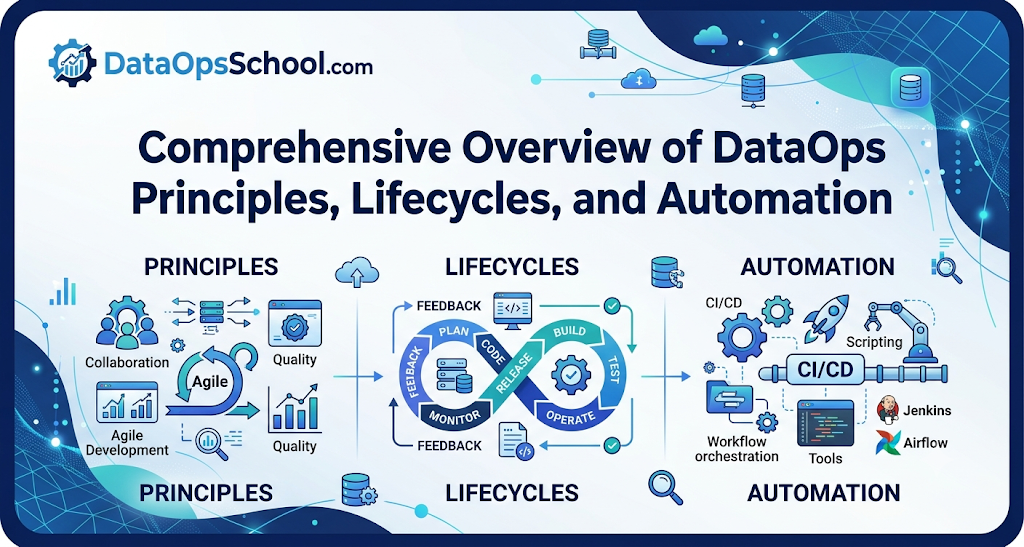
Core DataOps Principles
Successful DataOps implementations are guided by several foundational principles:
- Automate Everything: Reduce human error by automating pipeline deployments, testing cycles, and infrastructure provisioning.
- Version Control All Artifacts: Store code, configurations, schemas, and orchestration definitions in version control systems.
- Test Early and Often: Implement automated unit, integration, and data quality tests throughout the pipeline lifecycle.
- Monitor Continuously: Set up proactive alerting for pipeline failures, schema drifts, and anomalous data volumes.
- Iterate Incrementally: Break complex data initiatives into smaller, manageable, and deployable increments.
- Build for Reproducibility: Ensure that environments and data transformations can be recreated reliably.
DataOps Lifecycle
A robust DataOps lifecycle ensures that data assets are managed with the same rigor as software applications. The lifecycle typically flows through the following stages:
Plan → Develop → Integrate → Test → Validate → Deploy → Monitor → Improve
- Plan: Define pipeline requirements, data models, and service-level objectives (SLOs).
- Develop: Build transformations, ingestion scripts, and orchestration workflows in isolated environments.
- Integrate: Merge code changes into shared repositories using version control.
- Test: Execute automated code tests and structural data checks.
- Validate: Confirm business logic correctness and data semantics against expected benchmarks.
- Deploy: Push changes to production via automated CI/CD pipelines.
- Monitor: Track execution metrics, resource utilization, and pipeline runtime.
- Improve: Analyze failure logs and operational feedback to refine future iterations.
DataOps and Data Engineering
DataOps and data engineering are deeply intertwined, yet distinct in their scope. Data engineering focuses on building the foundational pipelines, architectures, and storage systems that ingest, transform, and store data.
DataOps provides the operational layer that surrounds data engineering. While an engineer builds an ETL or ELT pipeline, DataOps ensures that the pipeline is tested automatically, deployed safely via CI/CD, and monitored continuously in production. DataOps complements data engineering by introducing operational excellence and reliability standards.
DataOps and DevOps
While DataOps shares architectural lineage with DevOps, they serve distinct operational domains. The table below outlines their primary differences:
| Area | DataOps | DevOps |
| Primary Focus | Data delivery and operations | Software delivery and operations |
| Pipelines | Data pipelines and analytical workflows | Application delivery pipelines |
| Quality | Data quality, accuracy, and freshness | Code and software quality |
| Testing | Data validation, schema checks, and pipeline tests | Application and infrastructure testing |
| Monitoring | Data pipelines, data systems, and lineage | Applications, servers, and infrastructure |
| Collaboration | Data engineers, analysts, and scientists | Developers, SREs, and operations teams |
Many modern organizations combine both practices, utilizing DevOps principles for infrastructure and application layers while employing DataOps specifically for data-centric workflows.
DataOps Tools
DataOps relies on an ecosystem of specialized tools categorized by their operational functions:
- Orchestration: Tools that manage workflow dependencies and scheduling (e.g., Apache Airflow, Dagster, Prefect).
- Version Control & CI/CD: Systems for tracking code and automating deployments (e.g., Git, GitHub Actions, GitLab CI).
- Data Transformation & Testing: Frameworks for transforming and testing analytical models (e.g., dbt).
- Data Quality & Observability: Platforms that monitor data health, freshness, and anomalies (e.g., Great Expectations, Monte Carlo, Soda).
- Infrastructure Automation: Tools for provisioning cloud data environments (e.g., Terraform).
DataOps Automation
Automation is the engine that drives efficiency in DataOps. By removing manual interventions, teams can scale their data operations without a linear increase in headcount.
Key automation areas include automated pipeline execution, continuous deployment triggers upon code merge, automated data testing checks, and intelligent alerting mechanisms that route failure notifications directly to the responsible engineers.
Data Quality and DataOps
Data quality is a foundational pillar of DataOps. Poor data quality undermines trust and leads to flawed business decisions. DataOps embeds quality checks directly into the pipeline lifecycle.
Key dimensions of data quality include:
- Accuracy: Do the values reflect reality?
- Completeness: Are there missing records or null fields?
- Consistency: Do data points match across different systems?
- Timeliness: Is the data available when needed?
- Validity: Does data conform to defined formats and rules?
Data Observability and Monitoring
Basic monitoring tells an engineer whether a pipeline succeeded or failed. Data observability goes deeper, providing insight into why a pipeline behaved a certain way.
Observability tracks five core pillars: freshness, distribution, volume, schema changes, and lineage. By establishing clear metrics and proactive alerts, teams can diagnose downstream impacts before business users are affected.
CI/CD for Data
Applying Continuous Integration and Continuous Delivery (CI/CD) to data systems brings predictability to releases. However, data CI/CD introduces unique challenges, such as stateful data dependencies, large dataset volumes, and complex schema migrations.
A strong CI/CD data practice ensures that code changes are tested against staging datasets, backward compatibility is verified, and automated rollback mechanisms are ready if a deployment introduces anomalies.
DataOps Training
A comprehensive DataOps Training program bridges the gap between theoretical knowledge and practical execution. Effective training covers core fundamentals, data engineering integration, pipeline automation, CI/CD workflows, and advanced observability.
At DataOpsSchool.com, professionals find structured learning pathways designed to build real-world competency in modern data operations.
DataOps Course and DataOps Tutorial
Structured learning paths help learners progress from foundational concepts to advanced architecture. A well-designed DataOps Course or DataOps Tutorial typically follows this progression:
Fundamentals → Pipelines → Automation → Testing → CI/CD → Quality → Observability → Cloud Architecture
Learners start by understanding basic concepts and gradually move into building production-grade, observable, and automated data pipelines.
DataOps Certification
Pursuing a DataOps Certification validates a practitioner’s knowledge and commitment to professional excellence. Certification programs help structure learning objectives, confirm foundational understanding, and signal technical competency to peers and employers.
Certified DataOps Engineer
A Certified DataOps Engineer possesses specialized skills in building, automating, and maintaining resilient data pipelines. Core competencies include workflow orchestration, automated testing, CI/CD implementation, pipeline troubleshooting, and cloud data platform integration.
Certified DataOps Architect
A Certified DataOps Architect focuses on high-level enterprise design. Architects design scalable, secure, and governable data platforms, balancing cost, performance, and reliability across complex cloud environments.
DataOps Consulting
Organizations navigating cloud migration or pipeline scaling often engage in DataOps Consulting. Consultants evaluate existing architectures, identify automation bottlenecks, design CI/CD frameworks, and establish robust data quality practices.
DataOps Services
Professional DataOps Services encompass end-to-end implementation support, pipeline optimization, observability setup, and governance framework design, helping enterprises mature their data operations capabilities.
DataOps in the Cloud
Modern cloud data platforms provide the elastic compute and storage necessary for scalable DataOps. Integrating DataOps with cloud warehouses, data lakes, and lakehouse architectures ensures that infrastructure scales dynamically with data workloads.
Common DataOps Challenges
Organizations implementing DataOps often face legacy technical debt, siloed team structures, manual deployment habits, and tool fragmentation. Overcoming these challenges requires cultural alignment, incremental adoption, and strong leadership support.
Section 21 – DataOps Career and Learning Roadmap
- Learn DataOps fundamentals and agile principles.
- Master modern data engineering and ETL/ELT concepts.
- Gain proficiency in version control and CI/CD pipelines.
- Implement automated data testing and quality checks.
- Learn workflow orchestration tools.
- Explore data observability and monitoring systems.
- Understand cloud data platforms and infrastructure automation.
- Build portfolio projects demonstrating real-world pipelines.
- Pursue professional certification.
- Advance into architecture and consulting roles.
How DataOpsSchool Supports DataOps Learning and Implementation
DataOpsSchool.com serves as a specialized platform for individuals and teams looking to master modern data operations. Through comprehensive training modules, practical tutorials, professional certification pathways, and expert consulting services, DataOpsSchool equips professionals with the skills needed to build reliable, automated, and scalable data platforms.
DataOps Implementation Framework
Assess → Define Goals → Design Architecture → Select Tools → Automate → Test → Deploy → Observe → Govern → Optimize
Enterprises should adopt DataOps incrementally, starting with high-impact, low-risk pipelines before scaling the framework across the entire organization.
FAQ Section
- What is DataOps?DataOps is a collaborative, automated methodology that combines data engineering, CI/CD, testing, monitoring, and governance to improve the speed and reliability of data pipelines.
- What does DataOps training cover?DataOps training covers pipeline automation, workflow orchestration, data quality testing, CI/CD implementation, observability, and cloud data platform integration.
- What is a DataOps course?A DataOps course is a structured educational program designed to teach students and professionals how to build, test, and maintain automated data workflows.
- Is DataOps certification useful?Yes, DataOps certification helps validate technical knowledge, structures learning objectives, and demonstrates a professional commitment to modern data reliability practices.
- What skills are needed for a DataOps Engineer?A DataOps Engineer needs skills in workflow orchestration, data pipeline development, automated testing, version control, CI/CD, and monitoring tools.
- What does a DataOps Architect do?A DataOps Architect designs enterprise-scale data platforms, establishing governance, security, scalability, and high-level automation standards across cloud environments.
- What are DataOps tools?DataOps tools include workflow orchestrators, CI/CD runners, data quality testing frameworks, observability platforms, and infrastructure-as-code software.
- How does DataOps differ from DevOps?DevOps focuses on application software delivery and infrastructure, while DataOps specifically focuses on data pipelines, data quality, and analytical workflows.
- What does DataOps consulting involve?DataOps consulting involves assessing current data architectures, identifying automation gaps, and helping organizations implement robust CI/CD and monitoring practices.
- How can organizations implement DataOps?Organizations can implement DataOps by starting with an assessment of existing pipelines, introducing automated testing and CI/CD incrementally, and fostering cross-functional collaboration.
Conclusion
DataOps represents a fundamental shift in how organizations manage data, uniting engineering, automation, testing, CI/CD, and observability into a cohesive discipline. By mastering DataOps practices, professionals can eliminate operational bottlenecks and build resilient data systems. Explore our offerings at DataOpsSchool to accelerate your DataOps journey today.