Executive Summary
Modern enterprise engineering organizations face a paradox: they are investing more heavily than ever in advanced continuous integration, continuous delivery (CI/CD), cloud infrastructure, and observability tooling, yet visibility into true structural risk remains lower than ever. Deployments fail due to hidden configuration drift, security vulnerabilities pass through fragmented pipelines undetected, and developer productivity is hindered by fragmented architectures.
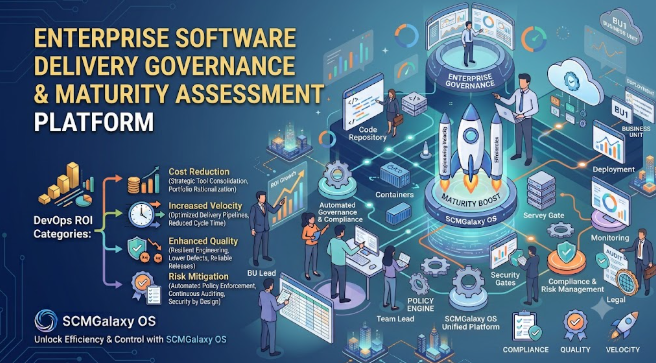
True engineering excellence cannot be purchased out-of-the-box through a vendor suite. It requires an architectural layer focused explicitly on software delivery governance. As a premier Software Delivery Governance Platform, SCMGalaxy OS operates above your existing tools, evaluating engineering maturity, identifying delivery risks, and generating the actionable transformation roadmaps needed to turn toolchains into competitive advantages.
The Toolchain Paradox: Why More Tools Fail to Equal Maturity
Enterprise technology organizations often evaluate their engineering health by auditing their vendor portfolio. If they utilize GitHub or GitLab for version control, Jenkins for pipelines, SonarQube for code quality, Terraform for Infrastructure as Code (IaC), Kubernetes for orchestration, and Datadog for monitoring, they assume their operations are optimized.
However, a highly fragmented toolchain frequently introduces hidden operational risk.
The Reality of Modern Delivery Ecosystems
- Siloed Insights: Each tool generates isolated telemetry data. A CI/CD tool understands pipeline speed but lacks context regarding whether code complies with regulatory frameworks or if the underlying architecture incurs severe technical debt.
- The “Black Box” Pipeline: Configuration drift occurs silently when manual interventions bypass Infrastructure as Code parameters. Kubernetes manifests might be deployed successfully, yet configuration flaws leave services vulnerable to performance degradation.
- Process Inconsistency: Across a large enterprise with dozens of distributed product lines, different engineering cohorts utilize the exact same toolset in vastly different ways, leading to unpredictable delivery quality.
This is exactly where SCMGalaxy OS changes the paradigm. Instead of replacing your existing investments, it unifies them under a single pane of glass, giving technology leaders total visibility into how safely, predictably, and efficiently those processes occur across the entire organization.
Defining Software Delivery Governance
Software delivery governance is the centralized framework used to assess, measure, govern, and optimize the entire software delivery lifecycle (SDLC). It does not replace code repositories, deployment orchestration engines, or cloud security tools. Instead, it operates above them, serving as an analytical and objective guardrail layer.
How Governance Differs from Standard Execution
| Functional Domain | Tool-Level Execution (Doing the Work) | SCMGalaxy OS Governance (Evaluating & Optimizing) |
| Source Control | Storing code branches in GitHub; running pull requests. | Evaluating branching strategies, commit health, and compliance with peer-review frameworks. |
| CI/CD Pipelines | Executing code builds and moving artifacts via Jenkins. | Verifying pipeline repeatability, failure recovery patterns, and gate adherence. |
| Infrastructure | Provisioning a cluster using HashiCorp Terraform. | Ensuring IaC templates pass static scanning, adhere to cost boundaries, and prevent drift. |
| Security | Running static application security testing (SAST) tools. | Validating that blockers prevent production promotion and that vulnerability management KPIs are met. |
By utilizing the Engineering Governance Platform provided by SCMGalaxy OS, engineering leaders can extract telemetry from fragmented tools to build a unified index of delivery health. This provides CTOs, enterprise architects, and platform managers with an objective evaluation mechanism rather than reliance on anecdotal team check-ins.
The Core Pillars of a Software Delivery Maturity Assessment
To achieve structural improvement across an enterprise, organizations must execute a thorough Software Delivery Maturity Assessment across several specialized engineering capabilities. SCMGalaxy OS automates this diagnostic process across six critical dimensions:
Software Configuration Management & Git Governance
Effective software configuration management (SCM) forms the bedrock of delivery predictability. A formal SCM Maturity Assessment reviews:
- Branching Strategy Hygiene: Ensuring teams avoid long-lived feature forks that delay feature integration.
- Artifact Tracking: Validating that every artifact promoted to an environment can be traced directly back to its precise commit cryptographic hash, parent pipeline run, and originating developer.
CI/CD & Deployment Governance
Moving artifacts through environments should be a non-event. A CI/CD Maturity Assessment looks beyond basic build metrics to scrutinize:
- Idempotency and Rollbacks: The ability of automated deployment mechanisms to return safely to a known good configuration during an outage without manual triage.
- Environment Parity: Evaluating whether staging, testing, and production runtime environments match exactly at the infrastructure layer to avoid configuration errors.
Release Management & Compliance
Uncontrolled releases trigger business disruptions. A robust Release Management Maturity Assessment verifies:
- Automated Auditability: Documenting that change-management workflows automatically log approvals and testing signs-offs to satisfy compliance regulations effortlessly.
- Decoupling Deployment from Release: Assessing the capability of using advanced strategies like blue-green deployments, canary testing, and feature flagging to systematically reduce runtime impact.
DevSecOps & Secure Software Delivery
Security must be integrated as an automated component within the pipeline rather than acting as a late-stage gate. A DevSecOps Maturity Assessment reviews:
- Software Supply Chain Security: Scanning open-source libraries, container base layers, and maintaining accurate Software Bills of Materials (SBOMs) to block malicious inputs automatically.
- Secrets Lifecycle Policies: Eliminating plaintext credentials hidden inside source control, ensuring tokens are dynamically injected via secrets management systems at runtime.
Observability, SRE, and Platform Engineering
An active application requires resilient maintenance post-deployment. An Observability and SRE Maturity Assessment reviews:
- Telemetry and Insights: Moving past raw logging toward actionable metrics, tracing, and structured alerting topologies tied to explicit Service Level Objectives (SLOs).
- Cognitive Load Reduction: Analyzing whether Internal Developer Platforms (IDPs) allow engineering cohorts to provision resources safely without wrestling with raw configuration complexities.
AI Code Governance
As generative AI code assistants are integrated into workflows, they present unique architectural and security challenges. An AI Code Governance Platform approach ensures:
- Code Provenance and Security: Guarding against license compliance violations and checking AI-generated logic for subtle algorithmic vulnerabilities.
- Efficiency Realization: Measuring whether AI assistance is driving real, high-quality production deliveries or simply generating a high volume of technical debt.
Measuring What Matters: Metrics and Maturity Frameworks
Many organizations struggle with metrics inflation—tracking dozens of irrelevant figures that fail to correlate with actual business outcomes. SCMGalaxy OS organizes your raw data around verified industry constructs (such as DORA and SPACE metrics) and instantly translates them into an actionable engineering maturity index.
Key Metrics Tracked via Governance Frameworks
- Deployment Frequency (DF): How often code is successfully pushed to production.
- Lead Time for Changes (LTFC): The duration from a developer’s commit to that code functioning actively in a production environment.
- Change Failure Rate (CFR): The percentage of deployments that trigger a subsequent degradation, rollout failure, or immediate hotfix.
- Mean Time to Restore (MTTR): The length of time required to remediate an unplanned service disruption in production.
By processing these metrics through the analytical engine of SCMGalaxy OS, companies map raw execution times against a standard progression path from Ad-Hoc/Reactive setups to a fully Optimized and Governed ecosystem. At the highest maturity levels, all pipelines run through automated policy guardrails, compliance logs are generated programmatically, and anomalies trigger zero-touch automated rollback responses.
Translating Assessment into Action: The 30/90/180-Day Roadmap
An engineering assessment loses its value if it results only in a static report. SCMGalaxy OS stands out by instantly translating your assessment scores into a dynamic, prioritized 30-, 90-, and 180-day transformation roadmap tailored to your enterprise needs:
- 30-Day Goal (Foundation & Risk Mitigation): Standardize branch naming and protection rules across Git repositories, eliminate plaintext secrets through automated scanning, and establish baseline DORA metrics tracking.
- 90-Day Goal (Automation & Continuous Integration): Enforce container and dependency scanning as a blocking pipeline gate, migrate manually configured environments into declarative IaC templates, and achieve 100% automated artifact promotion into non-production environments.
- 180-Day Goal (Advanced Optimization & Governance): Implement zero-touch progressive rollouts (Canary/Blue-Green deployments), transition to dynamic, compliance-driven automated audit generation, and establish automated self-healing mechanisms.
Best Practices for Implementing Engineering Governance
- Avoid Tool Duplication: Do not build a new execution layer. Leverage your existing pipeline investments and position a governance layer like SCMGalaxy OS on top to synthesize metrics and validate patterns.
- Automate Policies as Code: Compliance policies should not live in text files. Use tools like Open Policy Agent (OPA) to express policy rules directly as executable logic that pipelines can instantly parse and enforce.
- Prioritize Developer Experience (DevEx): Governance should not be designed as an obstacle course. Integrate security checks directly into standard IDE or CLI tools so developers catch bugs early without fracturing their daily concentration flow.
- Iterate Incrementally: Avoid broad, sweeping adjustments across fifty engineering groups simultaneously. Select a pilot team, validate your maturity assessment framework, fix identified gaps, demonstrate concrete performance gains, and expand from there.
6–10 Frequently Asked Questions
1. Why do we need software delivery governance if we already use an all-in-one DevOps toolchain?
While unified suites provide comprehensive tracking for their specific modules, enterprise architectures are rarely uniform. Most organizations manage hybrid setups across multiple ecosystems. SCMGalaxy OS sits above execution tooling to provide uniform visibility and check for compliance across disparate environments.
2. Does adding governance slow down engineering workflows?
When implemented correctly via SCMGalaxy OS, governance accelerates development velocities. By shifting compliance checks and testing procedures into automated background guardrails, engineers no longer have to manually prepare audit logs or wait for manual security sign-offs before pushing changes.
3. What is the difference between an engineering metric and engineering governance?
Metrics show raw numbers (e.g., “Our deployment frequency is 3 days”). Governance adds critical architectural context and maps out structural solutions (e.g., “Our deployment frequency is constrained by manual environment validation; we must update our IaC parameters within the next 30 days”).
4. How does governance handle AI-generated source code?
Governance structures view AI-generated changes like any other commit, but apply additional validation layers. This includes scanning for intellectual property exposure, checking for subtle algorithmic patterns that bypass traditional functional unit tests, and verifying changes against cost structures.
5. How often should an enterprise execute a maturity assessment?
Maturity tracking should operate as a continuous process rather than an annual project. SCMGalaxy OS continually evaluates incoming metrics and configurations against organizational benchmarks to provide engineering leaders with a real-time view of technical risk.
6. Is governance relevant to legacy monolithic platforms?
Yes. Governance principles apply regardless of the underlying runtime model. Whether an application runs on an on-premises server configuration or distributed Kubernetes nodes, managing dependencies, standardizing code review practices, and ensuring reliable releases are vital requirements.
Conclusion
True delivery maturity is not determined by the number of advanced tools an enterprise purchases. It is defined by the resilience, visibility, and repeatability of the delivery pipeline. By shifting focus from tool acquisition to strategic software delivery governance, engineering leaders gain deep clarity into structural risks, remove developer friction, and maintain strict security compliance.
SCMGalaxy OS provides the necessary analytics, real-time maturity scores, and structured roadmaps required to guide organizations through this engineering evolution—helping teams transform disparate dev tools into a secure, scalable, and optimized application delivery ecosystem.