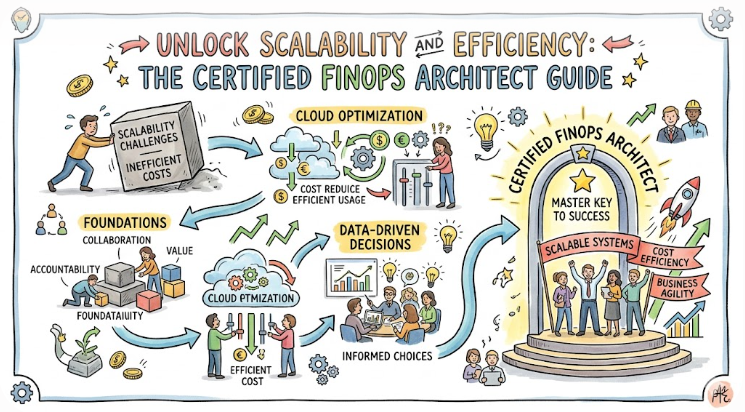
Introduction
Managing cloud infrastructure is no longer just about provisioning resources and ensuring high availability. Modern engineering requires a deep understanding of cost optimization, financial accountability, and cloud unit economics. This comprehensive guide explores how the Certified FinOps Architect designation helps technology professionals bridge the gap between engineering execution and business finance. Whether you work in DevOps, site reliability engineering, platform engineering, or cloud architecture, understanding cloud financial operations is essential for career growth. This roadmap, supported by resources from FinOpsSchool, provides a clear, hype-free analysis to help you make informed decisions about your professional development.
What is the Certified FinOps Architect?
The Certified FinOps Architect represents the peak of technical and financial convergence in modern cloud infrastructure management. It is a professional designation designed to validate an engineer’s ability to design, implement, and scale cloud financial operations frameworks across large organizations. Unlike introductory courses that focus merely on cloud cost terminology or basic dashboarding, this architectural certification focuses on production-grade optimization, automated governance, and architectural lifecycle management.
Enterprise cloud environments require systems that are cost-effective by design, rather than altered post-deployment. This certification confirms that a professional understands how to bake financial accountability directly into continuous integration and continuous deployment pipelines, infrastructure-as-code templates, and microservices architectures. It emphasizes real-world application, proving that a certified individual can collaborate effectively with finance teams while maintaining engineering velocity and system reliability.
Who Should Pursue Certified FinOps Architect?
This certification is designed for experienced technology professionals who influence infrastructure decisions and cloud spend. Cloud architects, DevOps engineers, systems engineers, and Site Reliability Engineers benefit immensely because it elevates their technical designs from working solutions to cost-optimized enterprise systems. Platform engineers who build internal developer platforms will find this knowledge crucial for embedding automated cost-guardrails into developer workflows.
The program also provides immense value to technical leaders, engineering managers, and enterprise directors who oversee large-scale cloud budgets. In the global IT market, including major tech hubs across India, Europe, and North America, enterprises are actively seeking professionals who can curb wasteful cloud spend without sacrificing performance. It serves as an excellent differentiator for senior engineers aiming to transition into principal, director, or enterprise architect positions.
Why Certified FinOps Architect is Valuable Now and Beyond
Cloud computing has matured past the stage of migration at all costs, moving into an era of strict fiscal discipline and operational efficiency. Organizations have realized that unmonitored cloud consumption directly damages corporate profitability and restricts capital for innovation. Holding a Certified FinOps Architect designation demonstrates that your skills remain highly relevant even as specific cloud provider tools evolve or shift over time.
This certification offers a high return on investment because it teaches foundational architectural principles rooted in data, culture, and automation. As multi-cloud and hybrid-cloud deployments become standard corporate practice, the ability to architect cloud solutions with financial clarity ensures long-term career longevity. It moves an engineer away from being a mere cost center and positions them as a strategic business asset who drives organizational efficiency.
Certified FinOps Architect Certification Overview
The Certified FinOps Architect program is structured to evaluate both technical depth and operational governance. The program is delivered through a structured curriculum and hosted on an enterprise-grade learning platform is FinOpsSchool. It avoids abstract theories, focusing instead on practical assessments, scenario-based architecture challenges, and rigorous examinations that mirror real-world cloud crises.
The certification framework tests candidates across multiple domains, including cost allocation, data ingestion, forecasting, and automated remediation. Individuals must demonstrate ownership of the FinOps lifecycle—specifically the Inform, Optimize, and Operate phases. The structure ensures that when a professional passes the assessment, they possess the immediate capability to lead a cloud financial transformation within an enterprise.
Certified FinOps Architect Certification Tracks & Levels
The certification journey is structured progressively to accommodate professionals at various stages of their cloud governance careers. It begins with foundational concepts that establish a common lexicon between engineering and finance professionals. This ensures that all candidates, regardless of their background, understand basic cloud billing mechanics and organizational alignment models.
As candidates progress to the professional and advanced architectural levels, the focus shifts toward deep technical implementation and cultural change management. Specialization areas allow engineers to align their FinOps training with their primary technical domains, such as container optimization, serverless architecture, or big data pipelines. This tiered progression ensures that the certification matches your growing responsibilities as a technology leader.
Complete Certified FinOps Architect Certification Table
| Track | Level | Who it’s for | Prerequisites | Skills Covered | Recommended Order |
| Cloud Financial Operations | Foundation | Cloud Beginners, Finance Teams | Basic Cloud Awareness | Cloud billing concepts, FinOps lifecycle, core terminology | First |
| Enterprise Architecture | Professional | Cloud Architects, DevOps Engineers | 2+ Years Cloud Experience | Unit economics, cost allocation, tagging strategies | Second |
| Infrastructure Governance | Advanced | Principal SREs, Platform Leaders | Professional Level Cert | Automated remediation, policy-as-code, financial modeling | Third |
Detailed Guide for Each Certified FinOps Architect Certification
Certified FinOps Architect – Foundation Level
What it is
This certification validates a professional’s understanding of foundational cloud financial management principles and the core components of the FinOps framework. It ensures alignment between technology, finance, and business teams.
Who should take it
It is ideal for cloud administrators, junior DevOps engineers, procurement specialists, and finance analysts who need to understand cloud billing data and collaborate effectively with technical engineering squads.
Skills you’ll gain
- Understanding cloud variable cost models and billing structures
- Navigating the Inform, Optimize, and Operate phases of FinOps
- Deciphering cloud invoices and utilizing basic cost exploration tools
- Establishing accountability metrics for shared cloud infrastructure
Real-world projects you should be able to do
- Design a basic cloud cost allocation and resource tagging strategy for a multi-department startup
- Generate monthly cloud spend visibility dashboards and anomaly notification workflows for stakeholders
Preparation plan
- 7–14 Days: Review official core terminology documentation, learn cloud billing structures, and understand basic cost optimization pillars.
- 30 Days: Take practice tests, build cost exploration dashboards in a lab environment, and review enterprise case studies.
- 60 Days: This short timeframe is rarely required for the foundation level, but you can use extra time to study specific multi-cloud billing quirks.
Common mistakes
- Treating cloud financial operations as a traditional, static IT procurement process rather than a continuous engineering practice
- Memorizing definitions without understanding how cloud auto-scaling impacts real-time billing cycles
Best next certification after this
- Same-track option: Certified FinOps Architect – Professional Level
- Cross-track option: Enterprise Cloud Infrastructure Associate
- Leadership option: Technical Program Management Essentials
Certified FinOps Architect – Professional Level
What it is
This certification verifies advanced competency in designing architectures that are cost-optimized by default. It proves capability in implementing tag enforcement, anomaly detection, and KPI-driven engineering practices.
Who should take it
This is built for senior DevOps engineers, cloud architects, and site reliability engineers who are directly responsible for infrastructure design and deployment.
Skills you’ll gain
- Engineering precise unit economics models for containerized and serverless environments
- Developing policy-as-code rules for automated resource optimization
- Managing reservation portfolios, savings plans, and spot instance integration
- Implementing advanced showback and chargeback accounting systems
Real-world projects you should be able to do
- Architect a Kubernetes cost-allocation system using open-source tooling to distribute shared cluster costs across multiple development teams accurately
- Create an automated cleanup pipeline that identifies, notifies, and terminates orphaned cloud resources after a specified period of inactivity
Preparation plan
- 7–14 Days: Focus heavily on container cost allocation strategies and advanced reservation mathematical equations.
- 30 Days: Implement policy-as-code guardrails in a test environment and analyze mock enterprise billing datasets.
- 60 Days: Conduct deep-dive reviews of complex multi-cloud enterprise architectures and practice resolving edge-case cost optimization scenarios.
Common mistakes
- Relying exclusively on manual modifications instead of building automated, code-driven cost guardrails
- Focusing so heavily on cost reduction that system performance, reliability, and security are compromised
Best next certification after this
- Same-track option: Certified FinOps Architect – Advanced Level
- Cross-track option: Principal Site Reliability Engineer
- Leadership option: Enterprise Cloud Director
Choose Your Learning Path
DevOps Path
Professionals focusing on rapid deployment pipelines should learn to embed cost visibility directly into continuous integration workflows. This involves setting up pull request gates that estimate infrastructure cost changes before code is merged. DevOps engineers will learn to treat financial metrics as standard quality gates, similar to security scanning or unit testing. This path bridges the gap between infrastructure deployment speeds and corporate financial oversight.
DevSecOps Path
Security and cost governance go hand-in-hand when managing enterprise infrastructure landscapes. This path emphasizes how security policies can also prevent financial leakage, such as shutting down compromised instances or unauthorized crypto-mining activities. Engineers learn to write policy-as-code rules that simultaneously validate compliance standards and cost efficiency profiles. The result is a secure, hardened, and financially optimized cloud ecosystem.
SRE Path
Site Reliability Engineers must master balancing system availability and performance against total operational expenditure. This path guides SREs to include cost metrics within service level objectives and error budgets. Professionals learn how to scale systems efficiently under heavy load while avoiding over-provisioning during idle periods. It shifts the reliability paradigm to include fiscal sustainability alongside uptime targets.
AIOps Path
Automating cost anomalies requires sophisticated machine learning models capable of distinguishing normal usage spikes from genuine waste. This path trains engineers to utilize artificial intelligence operations to predict future spending patterns based on historical data. Professionals focus on building self-healing infrastructure systems that dynamically adjust resource footprints based on real-time algorithmic predictions.
MLOps Path
Machine learning training pipelines are among the most expensive workloads running in modern clouds due to heavy GPU utilization. This path targets data science infrastructure specialists, teaching them how to optimize model training jobs, leverage spot instances for compute nodes, and manage storage lifecycles effectively. It ensures that large-scale artificial intelligence initiatives remain financially sustainable for the business.
DataOps Path
Data pipelines, warehousing systems, and large analytics clusters can quickly generate massive cloud invoices if left unchecked. This learning path teaches data platform engineers how to optimize query performance, manage data tiering, and build efficient storage architectures. Professionals learn to allocate compute costs accurately to specific analytical queries and business units, reducing overall data platform overhead.
FinOps Path
This dedicated track is for specialists who want to champion financial engineering across an entire global enterprise. It focuses deeply on cultural transformation, executive communication, and building cross-functional cloud centers of excellence. Practitioners learn to integrate cloud data with corporate accounting systems, drive organizational accountability, and lead widespread continuous improvement initiatives.
Role → Recommended Certified FinOps Architect Certifications
| Role | Recommended Certifications |
| DevOps Engineer | Certified FinOps Architect – Professional Level |
| SRE | Certified FinOps Architect – Professional Level |
| Platform Engineer | Certified FinOps Architect – Advanced Level |
| Cloud Engineer | Certified FinOps Architect – Foundation Level |
| Security Engineer | Certified FinOps Architect – Professional Level |
| Data Engineer | Certified FinOps Architect – Professional Level |
| FinOps Practitioner | Certified FinOps Architect – Advanced Level |
| Engineering Manager | Certified FinOps Architect – Foundation Level |
Next Certifications to Take After Certified FinOps Architect
Same Track Progression
After achieving architectural status, professionals should focus on mastering multi-cloud financial ecosystems. Deepening specialization involves understanding the nuanced differences between varied cloud provider discounting models, custom billing contracts, and billing API engines. Continuous study ensures your architecture remains optimized regardless of platform migrations.
Cross-Track Expansion
An architect should complement financial skills by pursuing advanced platform engineering or site reliability designations. Gaining expertise in service mesh implementations, advanced Kubernetes orchestration, or distributed systems architecture allows you to apply FinOps principles directly to complex, cutting-edge software deployments.
Leadership & Management Track
For those aiming to move into executive ranks, transitioning to advanced management certifications is the logical next step. Understanding corporate finance, strategic portfolio management, and organizational change frameworks helps an architect step out of the terminal and into the boardroom, transforming cloud efficiency into corporate strategy.
Training & Certification Support Providers for Certified FinOps Architect
DevOpsSchool provides comprehensive, instructor-led training regimens aimed at blending continuous delivery methodologies with financial governance practices for engineering teams.
Cotocus specializes in immersive, lab-driven bootcamps designed to give infrastructure professionals hands-on experience in managing enterprise cost-optimization challenges.
Scmgalaxy offers an extensive repository of community tutorials, configuration blueprints, and study materials centered around modern configuration management and infrastructure economics.
BestDevOps delivers structured corporate training modules that assist engineering squads in mastering automated cloud efficiency frameworks and modern delivery workflows.
devsecopsschool focuses on integrating safety compliance with financial guardrails, teaching professionals how to build secure and highly cost-efficient deployment pipelines.
sreschool provides targeted education that helps reliability professionals incorporate cost metrics directly into system availability blueprints and architecture patterns.
aiopsschool offers advanced curricula focused on leveraging machine learning workflows to automate infrastructure observation, anomaly detection, and resource management.
dataopsschool specializes in training data professionals to optimize big data architectures, cloud warehouses, and large-scale analytical processing jobs for maximum efficiency.
finopsschool serves as a core educational hub dedicated entirely to cloud financial operations, offering detailed courses, community forums, and comprehensive certification preparation paths.
Frequently Asked Questions (General)
- How difficult are cloud architecture examinations compared to standard engineering tests?Architectural examinations are significantly more challenging than standard associate tests because they move away from simple tool questions. They require you to analyze complex business scenarios, evaluate trade-offs between cost and performance, and design systemic solutions that span multiple infrastructure layers.
- Can an engineering background prepare me for the financial aspects of these certifications?
Yes, an engineering background is highly beneficial because financial optimization in the cloud is ultimately a technical problem. Understanding how resources consume memory, compute, and network bandwidth makes it much easier to grasp how those same resources generate financial line items. - How much time does the average professional need to dedicate to pass an advanced infrastructure exam?
An advanced exam typically requires between 30 to 60 days of consistent preparation, assuming you spend around 5 to 10 hours per week studying, reviewing architectural blueprints, and building practical automation labs. - Do these certifications require hands-on coding during the assessment phases?
While they may not require you to write raw application code from scratch, professional and advanced levels frequently test your ability to interpret infrastructure-as-code templates, read policy engine definitions, and analyze structured data outputs like JSON or CSV files. - What is the typical validity period for an enterprise cloud infrastructure certification?
Most enterprise tech certifications remain valid for a period of two to three years, after which professionals must undergo a recertification process or pass a higher-level examination to maintain their active credentials. - Are foundational certifications mandatory before taking advanced architectural exams?
It varies by program, but many tracks allow experienced professionals to skip foundational tests if they already possess documented real-world experience or hold equivalent engineering certifications from major cloud providers. - How do cloud optimization skills transfer across different cloud hosting providers?
The core concepts—such as rightsizing compute, tiering data storage, and setting up automated scaling parameters—are completely universal. Only the specific vendor tool names, pricing structures, and console interfaces change between different platforms. - Can non-technical project managers benefit from undertaking foundational infrastructure courses?Absolutely, because gaining a solid understanding of infrastructure terminology allows project managers to communicate more effectively with development squads, accurately forecast project delivery costs, and manage corporate timelines realistically.
- What role does policy-as-code play in modern enterprise cloud governance?
Policy-as-code is fundamental because it allows organizations to automate compliance rules. Instead of manually auditing infrastructure, engineers write scripts that automatically block non-compliant, overly expensive, or unapproved configurations from ever being deployed. - Do these training courses cover containerization and microservices cost management?
Yes, modern professional tracks place a massive emphasis on container systems like Kubernetes since they share resources dynamically, making accurate cost allocation and unit economics one of the most highly sought-after engineering skills. - How do organizations validate the credentials of an engineer claiming architectural certification?Organizations use secure digital badging platforms provided by the certification body, allowing employers to verify the candidate’s active status, issue date, and specific credential level instantly.
- Is it better to specialize in one cloud platform or maintain a multi-cloud understanding?
Maintaining a strong, multi-cloud structural foundation is generally better for long-term career resilience, as major modern enterprises frequently leverage hybrid strategies to avoid single-vendor lock-in and optimize global operational expenses.
FAQs on Certified FinOps Architect
- What specific value does a Certified FinOps Architect bring to an enterprise engineering team?
An architect ensures that financial accountability is embedded directly into the software development lifecycle, transforming cost management from a reactive accounting chore into a proactive engineering discipline that optimizes system efficiency automatically. - Are there any specific prerequisites recommended before attempting the professional level exam?Candidates should ideally possess at least two years of hands-on experience managing cloud systems, basic familiarity with enterprise accounting structures, and a firm grasp of infrastructure-as-code deployment practices.
- How does this certification help an engineer who does not manage company budgets?
It elevates your design capability, allowing you to present infrastructure proposals that justify technical decisions using business metrics, making you an invaluable asset to senior leadership teams. - Does the curriculum focus on a single specific cloud provider’s billing mechanisms?
No, the architectural framework teaches cloud-agnostic methodologies that can be applied universally across various platforms, ensuring your strategic capability remains effective regardless of an organization’s specific vendor selection. - How does a Certified FinOps Architect approach container optimization differently than a standard administrator?
An architect goes beyond basic rightsizing by implementing precise cluster allocation models, setting up real-time microservices tracking, and building automated scaling parameters that align closely with business demand patterns. - What is the core difference between the professional and advanced levels of this program?
The professional level focuses heavily on executing technical optimization tactics, while the advanced tier emphasizes broad enterprise governance strategies, cross-functional organizational culture shift, and building automated corporate guardrails. - Can a finance professional with zero programming knowledge successfully pass this examination track?
A finance professional can certainly succeed at the foundation level, but the professional and architectural paths require a solid grasp of technical cloud infrastructure, deployment pipelines, and system architectures. - How often is the educational content updated to reflect changes in cloud billing trends?
The program materials undergo continuous reviews to incorporate evolving cloud architectures, modern enterprise container practices, and the latest industry standards surrounding cloud financial operations.
Final Thoughts: Is Certified FinOps Architect Worth It?
Investing your valuable time and professional energy into obtaining the Certified FinOps Architect designation is a highly strategic career move. The tech landscape is full of engineers who can build functional cloud systems, but professionals who can design highly performant, reliable architectures that consciously manage business margins are rare. This certification proves to the market that you do not operate in a technical silo.
Rather than chasing brief software trends, mastering cloud financial operations provides you with an enduring framework rooted in business reality. It validates your capability to operate at the intersection of technology and corporate finance, making you an incredibly valuable asset to any modern enterprise. If your goal is to transition from an implementation engineer into a recognized strategic technology leader, this learning path is absolutely worth the effort.